Four ways Facebook changed the world
Online Desk
04 Feb 2024 14:25 PM
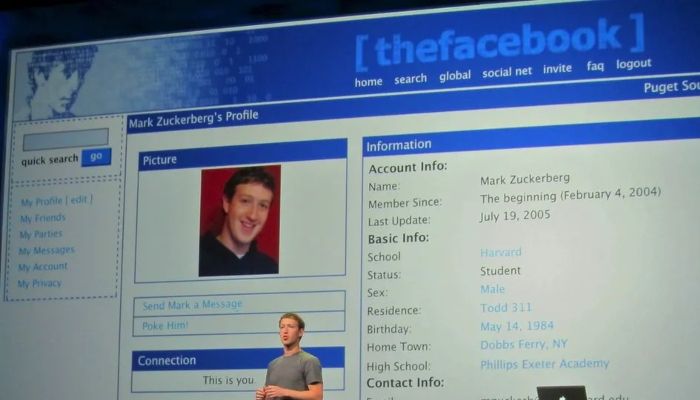
The world's most popular social network has been redesigned dozens of times
Look at the image above. This is how Facebook, or The
Facebook as it was then known, looked when Mark Zuckerberg and a handful of
friends launched it from their student digs 20 years ago.
Since then, the world's most popular social network has been
redesigned dozens of times.
But its aim has remained the same: to connect people online.
And make mountains of money from advertising.
As the platform turns 20, here are four ways Facebook has
changed the world.
1. Facebook changed the social media game
Other social networks, such as MySpace, existed before
Facebook - but Mark Zuckerberg's site instantly took off when it launched in
2004, proving just how rapidly an online site of this kind could take hold.
In less than a year it had one million users, and within
four years it had overtaken MySpace - fuelled by innovations such as the
ability to "tag" people in photos.
Taking a digital camera on a night out, then tagging your
friends in dozens of pictures was a staple of teenage life in the late
noughties. The constantly changing activity feed was also a big draw for early
users.
By 2012, Facebook had surpassed one billion users a month
and, aside from a brief blip at the end of 2021 - when daily active users
dropped for the first time - the platform has continued to grow.
By expanding into less connected countries and offering free
internet, the company has maintained and increased the number of Facebook
users. At the end of 2023, Facebook reported it had 2.11 billion daily users.
Admittedly, Facebook is less popular than it used to be with
young people. Nonetheless, it remains the most popular social network in the
world, and has ushered in a new era of social activity online.
Some see Facebook and its rivals as empowering tools for
connectivity. Others see them as addictive agents of destruction.
2. Facebook made our personal data valuable… and less
personal
Facebook proved that collecting our likes and dislikes is
extremely lucrative.
These days, Facebook's parent company Meta is an advertising
giant which, alongside the likes of Google, takes the lion's share of global
advertising money.
On Thursday Meta reported more than $40bn (£32bn) in revenue
for the last quarter of 2023, chiefly from offering advertisers highly targeted
ad services. Some $14bn was declared as profit.
But Facebook has also shown where data collection can go
awry.
Meta has been fined multiple times for mishandling personal
data.
The most publicised case was the Cambridge Analytica scandal
in 2014, which led to Facebook paying $725m to settle legal action due to a
significant data breach.
In 2022, Facebook also paid a €265m (£228m) EU fine for
allowing personal data to be extracted from the site.
And last year, the company was issued with a record €1.2bn
fine by the Irish Data Protection Commission, for transferring European users'
data outside of the jurisdiction. Facebook is currently appealing against the
fine.
3. Facebook made the internet political
By offering targeted advertising, Facebook has become a
major platform for election campaigning around the world.
For example, in the five months leading up to the US
presidential election of 2020, incumbent President Donald Trump's team spent
more than $40m on Facebook adverts, according to Statista research.
Facebook has had a hand in changing grassroots politics too
- by enabling disparate groups of users to gather, campaign and plan action on
a global scale.
Facebook and Twitter were said to be crucial during the Arab
Spring in helping to co-ordinate protests and spread the news about what was
happening on the ground.
But the adoption of Facebook for political ends has been
criticised for some of its consequences, including its impact on human rights.
In 2018, Facebook agreed with a UN report that said it had failed to prevent
people using the platform to "incite offline violence" against
Rohingya people in Myanmar.
4. Facebook kick-started Meta's dominance
With the huge success of Facebook, Mark Zuckerberg built a
social network and technology empire that remains unprecedented in terms of
users and its consequent power.
Up-and-coming companies, including WhatsApp, Instagram and
Oculus, were all purchased and turbo-charged under the umbrella company
Facebook, which changed its name to Meta in 2021.
Meta now says more than three billion people use at least
one of its products every day.
And when it hasn't been able to buy its rivals, Meta has
often been accused of copying them - in order to maintain its dominance.
Facebook and Instagram's disappearing Stories feature is
similar to a key feature found on Snapchat; Instagram Reels is the company's
answer to the challenge posed by video-sharing app TikTok; and Threads is
Meta's attempt to imitate X, formerly known as Twitter.
Tactics have become more important than ever, thanks to the
increased competition and a more strict regulatory environment.
In 2022, Meta was forced to sell GIF-maker Giphy at a loss
after UK regulators blocked it from owning the service due to fears of
over-dominance in the market.
/KN/
Source: BBC

