Russia accused of using phosphorus bombs in Bakhmut
Online Desk
06 May 2023 16:37 PM । Update: 06 May 2023 16:57 PM
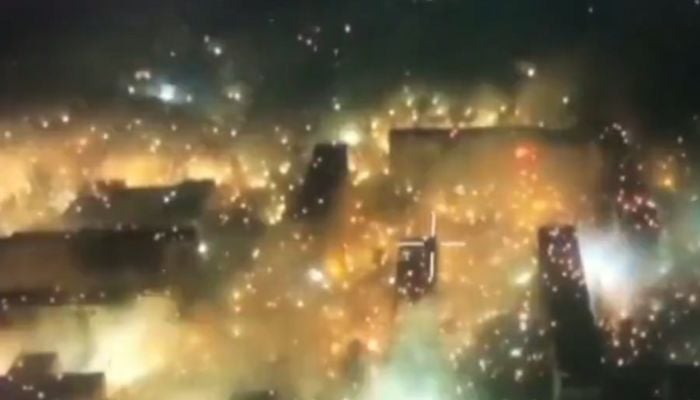
In drone footage released by Ukraine's military, Bakhmut can be seen ablaze as what appears to be white phosphorus rains down on the city. Picture: BBC
Ukraine has accused Russia of attacking the besieged city of
Bakhmut with phosphorus munitions. In drone footage released by Ukraine's
military, Bakhmut can be seen ablaze as what appears to be white phosphorus
rains down on the city.
White phosphorus weapons are not banned, but their use in civilian areas is considered a war crime. They create fast-spreading fires that are very difficult to put out, reports BBC. Russia has been accused of using them before.
Russia has been trying to capture Bakhmut for months,
despite its questionable strategic value. Western officials have estimated that
thousands of Moscow's troops have died in the assault.
Writing on Twitter, Ukraine's defence ministry said the
phosphorus attack targeted "unoccupied areas of Bakhmut with incendiary
ammunition".
Kyiv's special forces command added that Moscow's forces
continued "to destroy the city".
It is unclear when exactly the alleged attack took place.
But the footage shared by Ukraine - seemingly captured by a surveillance drone
- showed high-rise buildings engulfed in flames.
Other videos posted to social media showed fires raging on
the ground.
Russia has been accused of using white phosphorus several
times since it launched its full-scale invasion of Ukraine last year, including
during the siege of Mariupol at the beginning of the war.
Moscow has never publicly admitted to using white
phosphorous, and last year Kremlin Press Secretary Dmitry Peskov insisted
"Russia has never violated international conventions" after Ukrainian
President Volodymyr Zelensky said it had been used.
White phosphorus is a wax-like substance which ignites on
contact with oxygen, creating bright plumes of smoke.
Human Rights Watch (HRW) has warned the chemical is
"notorious for the severity of the injuries it causes".
It burns at 800 degrees Celsius and can cause extreme burns
on human flesh. It is also extremely sticky and hard to remove, and can re-ignite
when bandages are removed.
Russia is a signatory to the Convention on Certain
Conventional Weapons, which bans the use of incendiary weapons in civilian
areas - that is, those designed to catch fire.
But HRW says white phosphorus does not fall under the treaty
as its primary purpose is to "create a smokescreen to hide military
operations".
The chemical has been used "repeatedly over the past 15
years", including by US forces against IS fighters in Iraq and Syria,
according to HRW.
Some analysts say its use as an incendiary weapon near civilians would still be illegal. While Bakhmut had a pre-war population of 80,000, there are practically no civilians left in the area.
The attack comes a day after the commander of Russia's
Wagner paramilitary group said he would pull his forces out of Bakhmut on May
10 in a row over ammunition supplies.
Yevgeny Prigozhin said Wagner's casualties were
"growing in geometrical progression every day", and pinned his
decision to withdraw from Bakhmut squarely on the defence ministry.
Despite Prigozhin's claims, senior Ukrainian officials said
Wagner was actually redeploying mercenaries towards Bakhmut in a bid to capture
the city before Tuesday's Victory Day celebrations in Russia.
"We are now seeing them pulling [fighters] from the
entire offensive line where the Wagner fighters were, they are pulling [them]
to the Bakhmut direction," Deputy Defence Minister Hanna Maliar said on
Ukrainian television.
The intense fighting comes amid reports that Ukraine is
preparing to launch a large-scale counteroffensive in the coming weeks.
Prigozhin himself has said he believes the attack could come as soon as 15 May.
An offensive could take place in the Zaporizhzhia region
which is about 80% controlled by Russia.
On Friday, the Russian-installed governor of Zaporizhzhia
region said he had ordered the evacuation of villages near the front line.
Russia considers the area as its own territory, following self-styled referendums and an illegal annexation last year.

