Arab League re-admits Syria after 11-year absence
AFP
08 May 2023 13:07 PM
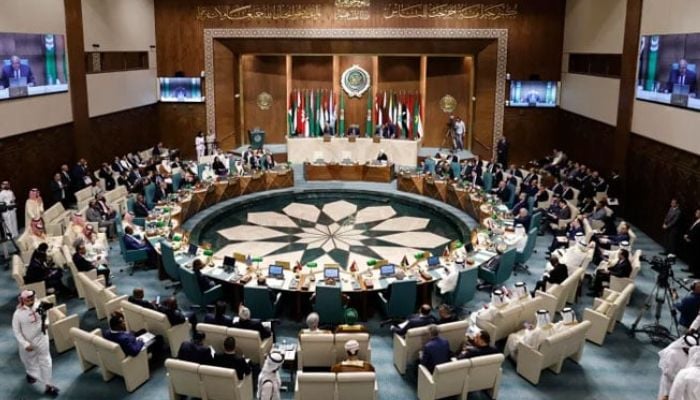
Egyptian Foreign Minister Sameh Shoukry speaks during an emergency meeting of Arab League foreign ministers in Cairo. Picture: AFP
The Arab League on Sunday welcomed back Syria's government,
ending a more than decade-long suspension and securing President Bashar
al-Assad's return to the Arab fold after years of isolation.
In November 2011, the body suspended Damascus over its
crackdown on peaceful protests which began earlier that year and which
spiralled into a war that has killed more than 5,00,000 people, displaced
millions and battered the country's infrastructure and industry.
While the front lines have mostly quietened, large parts of
the country's north remain outside government control, and no political
solution has yet been reached to the 12-year-old conflict.
"Government delegations from the Syrian Arab Republic will
resume their participation in Arab League meetings" starting Sunday, said
a unanimous decision by the group's foreign ministers.
The ministers in a statement emphasised their "keenness
to launch a leading Arab role in efforts to resolve" the Syria crisis.
They agreed to form a ministerial committee to continue
"direct dialogue with the Syrian government in order to reach a
comprehensive solution".
Ahmed Aboul Gheit, head of the 22-member Arab League, said
the decision "brings the Arab side into communication with the Syrian
government for the first time in years".
Syria's return to the body is "the beginning... not the
end of the issue", he added, noting it was up to individual countries to
decide whether to resume ties with Damascus.
'Diplomatic victory'
Following the announcement, Syria's foreign ministry
stressed the importance of "Arab cooperation", in a statement carried
by state news agency SANA.
"The next stage requires an effective and constructive
Arab approach... based on dialogue, mutual respect and common Arab
interests", it added.
Several Arab countries cut ties with Syria early in the
conflict, betting on Assad's demise, while some including Qatar and Saudi
Arabia provided support to the Syrian opposition.
Qatar on Sunday said it would not normalise relations with
Assad's government, but foreign ministry spokesman Majid bin Muhammad Al-Ansari
told state media Doha would not be "an obstacle" to the Arab move.
The last Arab League summit Assad attended was in 2010,
while the opposition attended the pan-Arab group's summit in Doha in 2013, to
Damascus's fury.
Aboul Gheit told a press conference Assad was welcome to
attend the Arab League's next summit on May 19 once invited by host Saudi
Arabia.
Regional capitals have gradually been warming to Assad as he
has stubbornly held onto power and clawed back lost territory with crucial
support from Iran and Russia.
The United Arab Emirates, which re-established ties in late
2018, has been leading the recent charge to reintegrate Damascus into the Arab
fold.
A February 6 earthquake that wreaked devastation in Turkey
and Syria sparked Arab outreach to Assad's government, while intensified
regional diplomatic activity has been underway since a March decision by rivals
Saudi Arabia and Iran to resume ties.
"Syria's regional isolation is officially broken,"
analyst Fabrice Balanche told AFP, calling Sunday's decision a "diplomatic
victory" for Assad.
Opposition 'abandoned'
April saw first a first Saudi official, Foreign Minister
Prince Faisal bin Farhan, visit Damascus since the start of the war, days after
a trip to Jeddah by Syrian Foreign Minister Faisal Mekdad.
Mekdad has travelled to a string of Arab countries in recent
weeks, including a May 1 meeting in Amman with counterparts from Jordan, Saudi
Arabia, Iraq and Egypt to discuss the long-running conflict.
Assad is hoping normalisation with wealthy Gulf nations
could bring economic relief and money for reconstruction.
With the war far from over and Assad still internationally
isolated, analysts say sanctions will likely continue to deter investment.
The Syrian National Coalition, the main opposition alliance,
said Sunday's decision meant "abandoning" and ignoring "the will
of the Syrian people", leaving them "without official Arab
support".
"It is unacceptable to allow (Assad) to avoid
punishment for the war crimes he has committed against Syrians," said the
Turkey-based coalition.
The Qatari foreign ministry spokesman said on Sunday
Damascus must "address the roots of the crisis that led to its boycott,
and to take positive steps towards addressing the issues of the Syrian
people".
In northwest Syria's rebel-held Idlib region, displaced
Syrians expressed frustration.
"We were pushed out of our homes," said Ghassan
Yussef, 54.
"I ask the Arab rulers: where are you taking us?"

