Cyclone Mocha death count rises to 60 in Myanmar
AFP
17 May 2023 09:45 AM
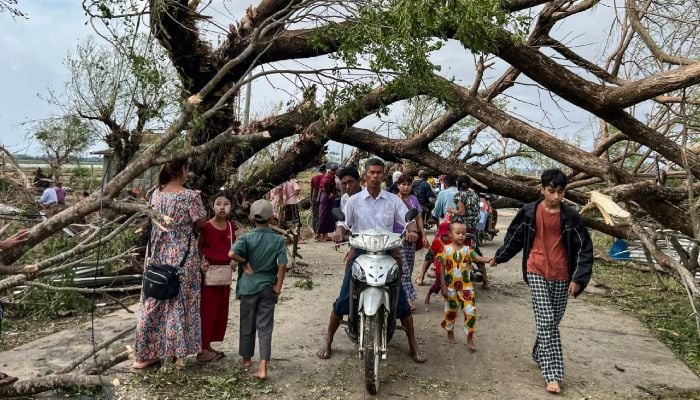
Residents walk past fallen trees in Kyauktaw in Myanmar's Rakhine state. AFP Photo
The death count in cyclone-hit Myanmar rose to 60 on
Tuesday, according to local leaders and junta-backed media, as villagers tried
to piece together ruined homes and waited for aid and support.
Packing winds of up to 195 kilometres (120 miles) per hour,
Mocha made landfall on Sunday, downing power pylons and smashing wooden fishing
boats to splinters.
In Rakhine state, at least 41 people died in the villages of
Bu Ma and nearby Khaung Doke Kar, inhabited by the persecuted Rohingya Muslim
minority, local leaders told AFP reporters at the scene.
Thirteen people were killed when a monastery collapsed in a
village in Rathedaung township north of Rakhine's capital Sittwe, and a woman
died when a building collapsed in a neighbouring village, according to Myanmar
state broadcaster MRTV.
"There will be more deaths, as more than a hundred
people are missing," said Karlo, the head of Bu Ma village near Sittwe.
Nearby, Aa Bul Hu Son, 66, said prayers at the grave of his
daughter, whose body was recovered on Tuesday morning.
"I wasn't in good health before the cyclone, so we were
delayed in moving to another place," he told AFP.
"While we were thinking about moving, the waves came
immediately and took us."
"I just found her body in the lake in the village and
buried her right away. I can't find any words to express my loss."
Other residents walked the seashore searching for family
members swept away by a storm surge that accompanied the cyclone, AFP correspondents
said.
State media had reported five deaths on Monday, without
offering details.
Mocha was the most powerful cyclone to hit the area in over
a decade, churning up villages, uprooting trees and knocking out communications
across much of Rakhine state.
China said it was "willing to provide emergency
disaster relief assistance", according to a statement on the Facebook page
of its embassy in Myanmar.
'No one has come to ask'
The United Nations refugee office said it was investigating
reports that Rohingya living in displacement camps had been killed in the
storm.
It was "working to start rapid needs assessments in
hard-hit areas" of Rakhine state, it added.
Widely viewed as interlopers in Myanmar, the Rohingya are
denied citizenship and healthcare, and require permission to travel outside of
their villages in western Rakhine state.
Many others live in camps after being displaced by decades
of ethnic conflict in the state.
In neighbouring Bangladesh, officials told AFP that no one
had died in the cyclone, which passed close to sprawling refugee camps that
house almost one million Rohingya who fled a Myanmar military crackdown in
2017.
"Although the impact of the cyclone could have been
much worse, the refugee camps have been severely affected, leaving thousands
desperately needing help," the UN said as it made an urgent appeal for aid
late Monday.
Cyclones – the equivalent of hurricanes in the North
Atlantic or typhoons in the Northwest Pacific – are a regular and deadly menace
on the coast of the northern Indian Ocean where tens of millions of people
live.
Non-profit ClimateAnalytics said rising temperatures may
have contributed to Cyclone Mocha's intensity.
"We can see sea surface temperatures in the Bay of
Bengal in the last month have been significantly higher than they were even 20
years ago," said the group's Peter Pfleiderer.
"Warmer oceans allow storms to gather power, quickly,
and this has devastating consequences for people."
On Tuesday, contact was slowly being restored with Sittwe,
which is home to around 150,000 people, AFP reporters said, with roads being
cleared and internet connections re-established.
Photos released by state media showed Rakhine-bound aid
being loaded onto a ship in commercial hub Yangon.
Rohingya villagers told AFP that they were yet to receive
any assistance.
"No government, no organisation has come to our
village," said Kyaw Swar Win, 38, from Basara village.
"We haven't eaten for two days... We haven't got
anything and all I can say is that no one has even come to ask."

