Syrians abandon babies at mosques, under trees as war grinds on
AFP
25 May 2023 13:25 PM
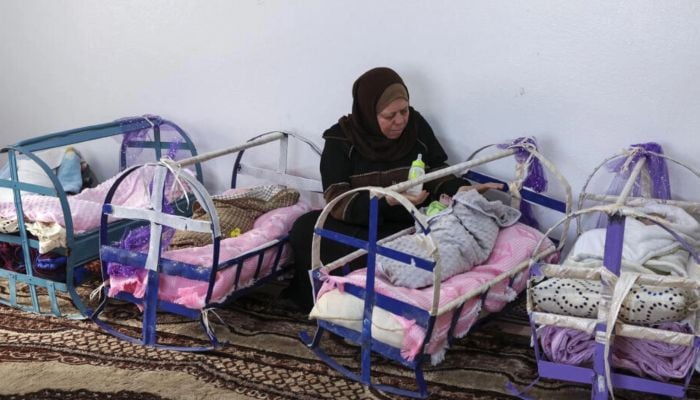
In Syria's rebel-held Idlib province, workers at the main centre for abandoned children tend to babies in basic cradles, some spruced up with purple paint or ribbons. AFP Photo
One cold winter night, Syrian Ibrahim Othman went out to
pray and came home cradling a baby girl, abandoned at the doorstep of the
village mosque just hours after she was born.
"I took her home and told my wife, 'I brought you a
gift'," said the 59-year-old resident of Hazano, in rebel-held northwest
Syria.
He named the baby Hibatullah, meaning "gift of
God", and decided to raise her as one of the family.
Officials say babies are being left outside mosques,
hospitals and even under olive trees in war-torn Syria as more than 12 years of
grinding conflict fuel poverty and desperation.
"Only a few cases of child abandonment" were
officially documented before the war broke out in 2011, according to the
Washington-based group Syrians for Truth and Justice, which records human
rights abuses in the country.
But between early 2021 and late 2022, more than 100 children
– 62 of them girls – were found abandoned across the country, it said in a
March report, estimating the real figure to be much higher.
"The numbers have increased dramatically" since
the start of the conflict along with "the social and economic
repercussions of the war" affecting both government-controlled and
rebel-held areas, the group said.
It pointed to factors including poverty, instability,
insecurity and child marriage, along with sexual abuse and pregnancy out of
wedlock.
While adoption is forbidden across Syria, Othman has asked
the local authorities for permission to raise Hibatullah.
"I told my children that if I die, she should have part
of my inheritance," even though she can never officially be part of the
family, he said, breaking into tears.
The three-year-old, her hair pulled back loosely into
pigtails and tottering around in shiny pink sandals, now calls him
"grandpa".
"She is just an innocent child," Othman said.
'Victims'
Syria's war has killed more than 5,00,000 people, displaced
millions and ravaged the country's infrastructure.
Health department official Zaher Hajjo told AFP that 53
abandoned newborn babies had been registered in government-controlled areas in
the first 10 months of last year – 28 boys and 25 girls.
Ibrahim Othman holds the girl, now aged three, he named Hibatullah
and decided to raise as a member of his family.
Syrian President Bashar al-Assad this year issued a decree
creating dedicated facilities for the children, who would be automatically
registered as Arab, Syrian and Muslim, with the place of birth as the location
they were found.
In rebel-held Idlib province, social workers at the main
centre for abandoned children tended to tiny babies wrapped tightly in blankets
in basic cradles, some spruced up with purple paint or ribbons.
In the bare-walled room with a brown-and-beige carpet, one
woman rocked a baby to sleep with one hand while feeding another milk with the
other.
Faisal al-Hammoud, head of programmes at the centre, said
one baby girl they took in was found under an olive tree after being mauled by
a cat.
"Blood was dripping down her face," he said,
adding that the orphanage had since entrusted her to a family.
Workers follow up to make sure such babies are well treated
and "that there is no child trafficking", Hammoud added.
The centre has taken in 26 babies – 14 girls and 12 boys –
since it opened in 2019, and nine this year alone, said Abdullah Abdullah, a civil
affair official with Idlib's rebel authorities.
More than four million people live in areas controlled by jihadists
and Turkish-backed groups in Syria's north and northwest, 90 percent of whom
depend on aid to survive.
"The war is to blame and families too" for child
abandonments, Abdullah said.
"These children are victims," he added.

