Grim quest to find loved ones from Indian train disaster
AFP
04 Jun 2023 13:11 PM
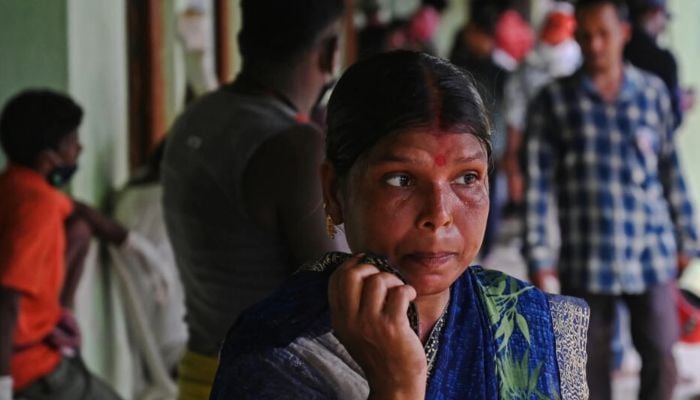
A woman searches for the body of a family member at makeshift morgue in a high school in eastern Indian after a train collision killed 288 people. AFP Photo
At a makeshift morgue in an Indian school, a couple scanned
photos of disfigured corpses before leaning in for a closer look at one they
think is their 22-year-old son.
A pendant around his wounded neck provided the terrible
confirmation.
The mother held back tears and leaned gently on her
husband's shoulder for a few seconds, before looking away from the laptop of an
official trying to identify the dead after India's worst train disaster in decades.
People have come to the Bahanaga High School, less than a
kilometre from the crash site near Balasore, in the eastern state of Odisha,
since Friday's horrific three-train collision.
At least 288 people were killed and hundreds more injured.
Some train carriages were flipped over, others were torn
open with the force of the impact.
"The dead bodies that came here were already in a very
bad state," said Arvind Agarwal, the official in charge of the makeshift
morgue. The searing heat has "further disfigured" many of them, he
said.
"The biggest challenge is the identification,"
Agarwal said, sitting in the school headmaster's office.
Volunteer Siddharth Jena, 23, sat next to him with a laptop
that has numbered pictures of every body recovered and sent to the school since
Friday night.
Corridors lined with corpses
The stench of rotting flesh hung in the air around the
school.
Dozens of people sat outside its gates hoping to find their
missing relatives.
Once a family has identified their relative from photos,
they are given a receipt that allows them to view the body. But it has been far
from simple.
"We received 179 bodies here, but only 45 of them could
be identified," said Ranajit Nayak, the police officer in charge of
releasing the bodies.
Bodies in white bags tagged "identified" or
"unidentified" lined both sides of the blood-stained corridor late on
Saturday, with others stored in classrooms.
"There were bodies with only a torso, an entirely burnt
face, disfigured skull and no other visible identity markers left," Nayak
said.
"Did you expect that this identification would be easy
for anyone?"
Work began late on Saturday to move unidentified bodies to a
centre with better facilities to preserve the bodies for relatives travelling
longer distances.
Unidentified corpses will then be moved to permanent city
morgues.
For some, like Abhijit Chakrabarty, 27, from neighbouring
West Bengal state, the wait was over. He saw a photograph with a bracelet worn
by his missing 25-year-old brother-in-law Subhashish.
But others continued their desperate search. Agarwal, the
official at the school, warned that some families might have to take DNA tests
to provide matches.
Noor Jamal Mondon, 38, from Bardhaman district in West
Bengal, has heard nothing from his missing brother Yaad Ali, 35.
"We've checked all the hospitals and the crash site throughout the day," said Mondon, an imam at a mosque. "We are now looking at the dead bodies at the morgue once again."

