Antony Blinken lands in China on rare visit to lower temperature
AFP
18 Jun 2023 09:27 AM
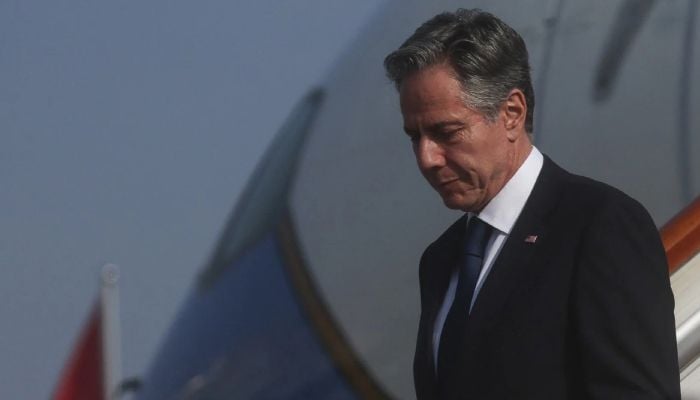
Antony Blinken is the first top US diplomat to visit Beijing since 2018. AFP Photo
Secretary of State Antony Blinken arrived in China on Sunday
on the highest-level trip by a US official in nearly five years, with the rival
powers looking to lower the temperature after soaring tensions.
Neither side expects breakthroughs during Blinken's two-day
visit, with the world's two largest economies at odds on an array of issues
from trade to technology to regional security.
But the two countries have increasingly voiced an interest
in seeking greater stability and see a narrow window before elections next year
both in the United States and Taiwan, the self-ruling democracy which Beijing
has not ruled out seizing by force.
In a sign of the fragility of the effort, Blinken had been
due to visit four months ago, the fruit of a cordial summit between Presidents
Joe Biden and Xi Jinping in Bali in November.
But Blinken abruptly postponed the trip after the United
States said it detected a Chinese spy balloon over US soil, leading to furious
calls for a response by hardliners in Washington.
Speaking in the US capital before his departure, Blinken
said he would seek to "responsibly manage our relationship" by
finding ways to avoid "miscalculations" between the countries.
"Intense competition requires sustained diplomacy to
ensure that competition does not veer into confrontation or conflict," he
said.
Keeping allies close
Blinken was speaking alongside Singaporean Foreign Minister
Vivian Balakrishnan, who said that the region wanted the United States both to
stay as a power and to find ways to coexist with a rising China.
Blinken's "trip is essential, but not sufficient",
Balakrishnan said.
"There are fundamental differences in outlook, in
values. And it takes time for mutual respect and strategic trust to be built
in."
As part of the Biden administration's focus on keeping
allies close, Blinken spoke by telephone with his counterparts from both Japan
and South Korea during his 20-hour trans-Pacific journey.
Biden's national security advisor, Jake Sullivan, travelled
separately to Tokyo for separate three-way meetings involving Japan and both
South Korea and the Philippines.
In recent months the United States has reached deals on
troop deployments in southern Japan and the northern Philippines, both
strategically close to Taiwan.
Beijing carried out major military drills around Taiwan in
August, seen as practice for an invasion, after Nancy Pelosi, then speaker of
the US House of Representatives, visited.
And in April, China launched three days of war games after
Taiwanese President Tsai Ing-wen visited the United States and met the current
speaker, Kevin McCarthy.
China's 'core concerns'
Ahead of Blinken's visit, Chinese foreign ministry spokesman
Wang Wenbin said that the United States needed to "respect China's core
concerns" and work together with Beijing.
"The US needs to give up the illusion of dealing with
China 'from a position of strength'. China and the US must develop relations on
the basis of mutual respect and equality, respect their difference in history,
culture, social system and development path," he said, a nod to frequent
US criticism of China's rights record.
Blinken is the first top US diplomat to visit Beijing since
a brief stop in 2018 by his predecessor Mike Pompeo, who later championed
all-out confrontation with China in the final years of Donald Trump's
presidency.
The Biden administration has kept in place Trump's hard line
in practice if not tone and has gone further in areas, including working to ban
exports to China of high-end semiconductors that have military uses.
But unlike Trump, who is running again for president, the
Biden administration has said it is willing to work with China on narrow areas
of cooperation such as climate – as Beijing sweats in record mid-June
temperatures.
Danny Russel, who was the top diplomat on East Asia during
Barack Obama's second term, said that each side had priorities – with China
seeking to forestall additional US restrictions on technology or support for
Taiwan, and the United States eager to prevent an incident that could spiral
into a military confrontation.
"Blinken's brief visit will not bring resolution to any
of the big issues in the US-China relationship or even necessarily to the small
ones. Neither will it stop either side from continuing with their competitive
agendas," said Russel, now a vice president at the Asia Society Policy
Institute.
"But his visit may well restart badly needed
face-to-face dialogue and send a signal that both countries are moving from
angry rhetoric at the press podium to sober discussions behind closed doors."
/KN/

