UN rights council split after debate called over Quran burnings
AFP
12 Jul 2023 10:16 AM
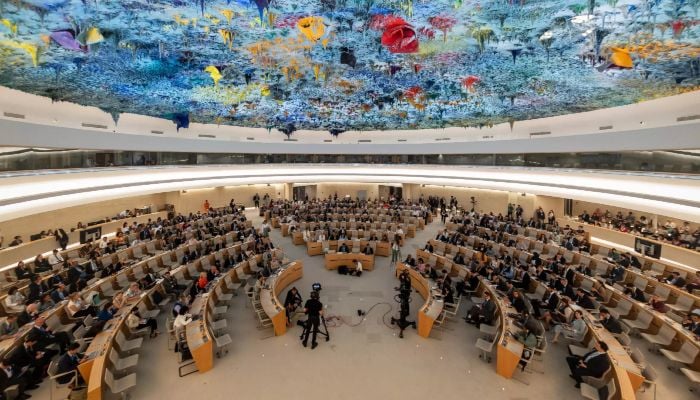
The UN Human Rights Council meets at the Palais des Nations in Geneva. AFP Photo
The UN Human Rights Council is heading towards a divisive
vote on Wednesday on religious hatred following recent Quran burnings, with
some Western nations reluctantly feeling the draft resolution encroaches too
far on free speech.
Pakistan and other Organisation of Islamic Cooperation
countries secured an urgent debate at the UN's top rights body on Tuesday after
a Quran was burnt outside Stockholm's main mosque, triggering a diplomatic
backlash across the Muslim world.
Pakistan's draft resolution condemns all manifestations of
religious hatred, including "public and premeditated acts of desecration
of the Holy Quran", and underscores the need to hold those responsible to
account.
It urges states to adopt laws to "address, prevent and
prosecute acts and advocacy of religious hatred that constitute incitement to
discrimination, hostility or violence".
It also wants the UN rights chief Volker Turk to identify
gaps in countries' laws in light of Tuesday's Quran burning debate.
Worried about freedom of expression – however distasteful –
some Western nations on the 47-member council were holding out for revised
wording that would allow them all to reach a consensus.
But with Pakistan submitting its resolution, the European
Union countries, the United States and Britain – while condemning Quran
burnings – resigned themselves to a vote instead, with London and Washington
saying they would vote against the draft resolution.
After four hours of debate, the council in Geneva was on the
brink of voting on Tuesday. However, it narrowly ran out of time, meaning they
will return at 10:00am (0800 GMT) on Wednesday.
'Deliberate desecration'
"The deliberate desecration of the holy Quran has
continued under government sanction and with a sense of impunity,"
Pakistan's Foreign Minister Bilawal Bhutto Zardari told the council, via
video-link.
"Free speech is as indispensable as hate speech should
be indefensible. Our vigour to protect free speech must not lose sight of the
imperative to reject hate speech."
Indonesian Foreign Minister Retno Marsudi added: "These
provocations deeply insult Muslims around the world. You cannot hide behind
freedom of expression."
In a brief intervention, Sweden's representative said
Stockholm "strongly rejects any Islamophobic acts".
Some countries feel existing resolutions go far enough.
France's ambassador Jerome Bonnafont noted: "Human
rights protect people -- not religions, doctrines, beliefs or their symbols.
"It is neither for the United Nations nor for states to
define what is sacred."
Opening the debate, UN rights chief Turk said recent Quran-burning
incidents seemingly "manufactured to express contempt and inflame
anger".
"Powered by the tidal forces of social media... hate
speech of every kind is rising, everywhere," he said.
Turk said that "people need to act with respect for
others", with inflammatory acts against religions being "offensive,
irresponsible and wrong".
But, he stressed, limitations on free speech "must, as
a matter of fundamental principle, remain an exception".
Western hopes for consensus
US ambassador Michele Taylor said she had "so
hoped" the council could "speak with one consensus voice".
"While we abhor expressions of religious hatred, we do
not believe freedom of expression can or should be abridged to outlaw them.
Accordingly, we regret that we must vote against this text," she said.
British ambassador Simon Manley said it was difficult to
determine where free speech becomes unacceptable.
"We don't accept that, by definition, attacks on
religion, including our religious texts or symbols, constitute advocacy for
hatred," he concluded.
Belgium's ambassador Marc Pecsteen, speaking for the EU,
deeply regretted there was "no will" to keep negotiating for a
consensus and the bloc therefore "has no other choice than to ask for a
vote".
On June 28 in Stockholm, Salwan Momika, 37, who fled from
Iraq to Sweden several years ago, stomped on the Muslim holy book and set
several pages alight.
His actions came as Muslims around the world began marking
the Eid al-Adha holiday.
The Swedish government condemned the Quran burning as
"Islamophobic", but added that Sweden had a
"constitutionally-protected right to freedom of assembly, expression and
demonstration".
/KN/

