Military ties to take centre stage as Modi visits France
AFP
13 Jul 2023 12:01 PM
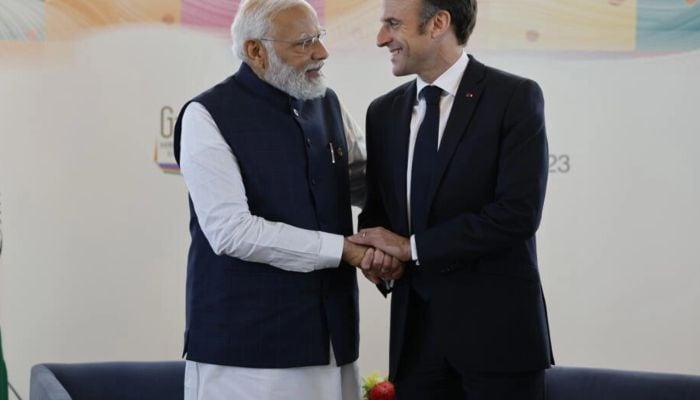
Indian Prime Minister Narendra Modi (L) and French President Emmanuel Macron. AFP File Photo
Indian Prime Minister Narendra Modi begins a two-day visit
to France on Thursday where he will attend the traditional Bastille Day
military parade as guest of honour and discuss major new defence deals.
French President Emmanuel Macron's red-carpet welcome for
the Hindu nationalist leader comes weeks after Modi was given the rare honour
of a White House state dinner in Washington – a city he was once banned from
visiting.
Despite differences over the war in Ukraine and tensions
over human rights in India, New Delhi and Western democracies are keen on
deepening ties because of mutual concerns about China.
"India is one of the pillars of our Indo-Pacific
strategy," an aide to Macron told reporters this week on condition of
anonymity.
Macron has made Modi guest of honour for the July 14
military parade, which kicks off France's national day celebrations, with the
participation of Indian troops and Indian-flown French-made fighter jets
underlining close defence ties.
India is one of the biggest buyers of French arms, with Modi
announcing a landmark deal for 36 Rafale fighter jets during a trip to Paris in
2015 that was worth around 4.0 billion euros ($4.24 billion) at the time.
He is set to unveil the purchase of another 26 marine
versions of the state-of-the-art aircraft during this visit, as well as a deal
for three Scorpene-class submarines, according to reports by the Tribune news
website in France and the Hindustan Times newspaper in India.
New Delhi is seeking to rapidly modernise its armed forces,
with fears about China's assertiveness heightened by simmering disputes along
its Himalayan frontier.
Rights concerns
Modi has visited France four times since Macron came to
power in 2017, while Macron was feted on a state visit to New Delhi in 2018.
Aides on both sides have talked up the personal chemistry
between the two leaders and pointed to cooperation on climate change and solar,
space technology and nuclear power, as part of the 25-year-old "strategic
partnership" between France and India.
The visit is set to be "both rich in substance and also
in form and we believe that it would set new benchmarks for our strategic
partnership in years ahead", Indian Foreign Secretary Vinay Kwatra told
reporters on Wednesday.
But the 72-year-old Indian leader remains a controversial
figure at home and in the West, dating back to his tenure as chief minister of
the western state of Gujarat in 2002 when around 1,000 people, mostly Muslims,
were killed in sectarian riots.
He has been dogged by allegations that he was complicit in
the violence and was once subject to a US State Department travel ban over his
role. Indian government probes have cleared him of culpability.
Since his first crushing electoral victory in 2014, Modi has
regularly been denounced by rights groups for increased discrimination and
violence towards the country's Muslims, as well as stifling independent media.
Leading French academic Christophe Jaffrelot said Modi was
"in the process of deconstructing India's democratic institutions" in
an article published this week.
Few observers expect Macron to raise rights concerns
publicly.
"The fact that explains France's relative success in
this relationship is that unlike the US, the UK, Canada, Germany and a few
other European countries, you've hardly seen France commenting on the internal
affairs of India," Constantino Xavier from the Centre for Social and
Economic Progress, a New Delhi-based think tank, said this week.
"That has been appreciated on the Indian side."
Balancing game
India has also become a vital market for Western companies,
its swelling middle classes helping the economy to the fifth-biggest in the
world.
Many European and American businesses including US tech
giant Apple are also ramping up production in India to mitigate the threat of
supply chain disruptions from China.
The war in Ukraine has heightened concerns in the West about
the risk of conflicts disrupting the flow of key raw materials and technology
from China, but it has also exposed a rift with India.
New Delhi, which has long sought to balance its ties with
Moscow and the West, has declined to condemn Vladimir Putin's invasion of
Ukraine and has emerged as a top buyer of discounted Russian oil during the
biggest conflict in Europe since World War II.
"This has been a major stumbling block for the
India-Europe partnership," said Garima Mohan, an Indian foreign policy
expert at the German Marshall Fund of the United States, a think tank, during
an online debate at the Brookings Institution this week.
/KN/

