At Belarus border, Ukrainians alert over Wagner threat
AFP
16 Jul 2023 12:34 PM
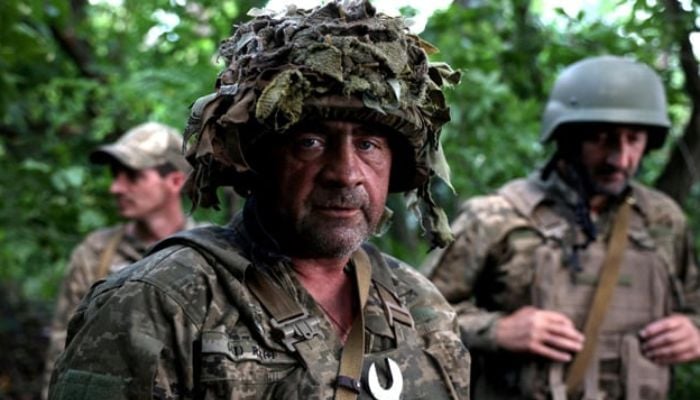
At a long-closed crossing point from Ukraine to Belarus,
Oleg, a camouflage-clad guard carrying a Kalashnikov, says he has seen no sign
of Wagner mercenaries across the border, some 150 metres away.
Ukraine's military said it was reinforcing the border with
Belarus with trenches and mines as some Russian mercenaries were expected to
move to the country following their aborted mutiny against Moscow's top brass.
Ukraine is ready to "rebuff" Russia's forces
including Wagner, said Oleg, 26, as he patrolled the Slavutych border crossing
point, closed since February 24 last year, when Russian forces entered the
Chernigiv region from Belarus at the start of the invasion.
"Since we were stabbed in the back from the territory
of Belarus, we do not reject... that there may be some movements or deployment
of Wagner fighters on Belarusian territory," Oleg told AFP.
Uncertainty persists over the fate of the mutinous Wagner
troops since a deal was sealed between Moscow and Minsk, which should have seen
some of them move to Belarus.
The Belarusian defence ministry confirmed on Friday that at
least some had arrived, and were instructing local troops.
President Volodymyr Zelensky downplayed the move, saying
Ukraine was "closely monitoring developments there from a security perspective,
and currently, there are no major threats".
'It's so close'
Driving south to the nearby village of Dniprovske, there
were signs of activity in the woods: men in camouflage and fortifications, as
well as a dummy figure positioned at the roadside.
The village's main street has two shops, a war memorial and
church. A family of storks was nesting on top of a telegraph pole.
Smallholder Viktor Koren, 76, was walking to the shop to buy
sour cream.
He drew in the dust with his stick to show how close he lives
to the Dnipro river that forms the border.
"Of course I'm nervous. Because it's so close. There is
a river near us, a border, and these assholes are fighting across the
border," he said, referring to Russians.
He slammed Wagner chief Yevgeny Prigozhin for aborting his
revolt against Moscow and allying with Belarusian President Alexander
Lukashenko.
"He was going to Moscow and he didn't make it there...
Why didn't he defeat them?" he said.
Stocking shelves in a grocery store, 20-year-old Ilya Bobok
said he was confident that Ukraine could withstand any new attack.
"The first time they (Russians) had the element of
surprise. Now I think, it's not going to work. We already have people trained
in combat. Brave guys. I think there's nothing to be scared of."
"They may try but they'll be out of here very
quickly."
The shop's owner, Kateryna Bobok, 37, echoed his confidence.
"If you've seen the guys protecting us, how can you be
nervous?" she said.
She said she had heard on the news about Wagner's possible
presence in Belarus but had seen "no signs that anything has
changed".
"It's even a little quieter, which is a little bit
alarming."
'Controlled, calm'
At the border there were weeds growing up through the tarmac
and rusted signs about customs rules.
Before the war, around 500 vehicles a day passed through the
crossing point.
On the morning of the invasion on February 24, Ukrainian
border guards blew up a road bridge over the Dnipro river, which forms the
border with Belarus.
Russian forces managed to enter the Chernigiv region that
day anyway, which saw fierce fighting until they withdrew in April 2022. The
region is still regularly shelled.
Oleg said Ukrainian forces estimate around 2,000 servicemen
from Russia's conventional army to be on Belarusian territory as well as planes
and helicopters from Russia's Space Forces.
The situation on the border is "controlled, calm, we
don't record any provocations from the Belarusian side," Oleg said.
/KN/

