Pak parliament to dissolve for election without Imran Khan
AFP
09 Aug 2023 09:39 AM
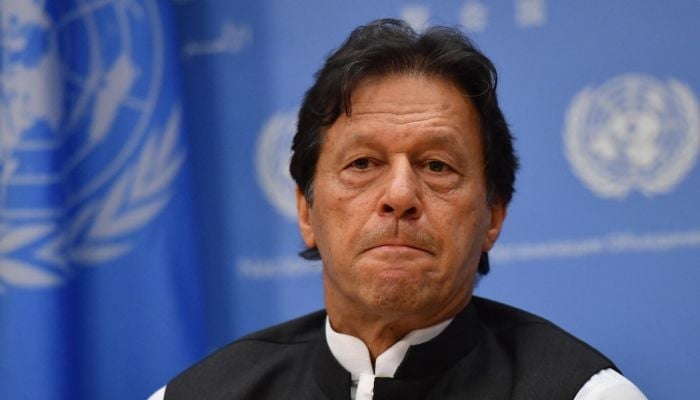
Pakistan's former PM Imran Khan. AFP File Photo
Pakistan's parliament was due to be dissolved Wednesday,
ushering in a technocrat-led interim government to oversee an election that
will not include the country's most popular politician, Imran Khan.
The country has been in political turmoil since the former
international cricket star was booted from power in April last year,
culminating in his being jailed for graft at the weekend following a
months-long crackdown on his party.
By law, elections should be held within 90 days of
parliament's dissolution, but the outgoing government has already warned they
are likely to be delayed.
The unlikely coalition between the country's usually feuding
dynastic parties – which came together to kick out Khan – has won little
popular support during its 18 months at the helm of the world's fifth-most
populous country.
The economy is still in the doldrums despite a new
International Monetary Fund bailout, with crippling foreign debt, soaring
inflation and widespread unemployment from factories made idle because they lack
foreign currency to buy raw materials.
"Economic decisions are invariably tough and often
unpopular, requiring a government with a longer tenure to effectively implement
them," said Ahmed Bilal Mehboob, president of the Pakistan Institute of
Legislative Development and Transparency think tank.
"This election holds significance as it will result in
a five-year term for a new government, which ideally should be empowered to
make essential decisions vital for economic recovery."
Question mark over election date
There has been speculation for months that there could be a
delay to elections as the establishment grapples to stabilise the country,
which is facing overlapping security, economic and political crises.
Data from the latest census carried out in May was finally
published at the weekend and the government says the election commission needs
time to redraw constituency boundaries -- a sore point for several political
parties.
Michael Kugelman, director of the South Asia Institute at
the Wilson Center, told AFP that any delay could give time to the main
coalition partners, the Pakistan Muslim League-Nawaz (PML-N) and Pakistan
Peoples Party (PPP), to figure out how to address the challenge of PTI.
"But in reality, delaying the election could simply anger
the public more and galvanize an opposition that has already suffered through
months of crackdowns," he said.
Behind any election in Pakistan lurks the military, which
has staged at least three successful coups since the country was forged from
the partition of India in 1946.
Khan enjoyed genuine widespread support when he came to
power in 2018, but analysts say it was only with the blessing of the country's
powerful generals -- who he reportedly fell out within the months before his
ousting.
He later waged a risky campaign of defiance against the
military, accusing them of meddling in politics and even naming an intelligence
officer as being behind an assassination attempt that saw him shot in the leg
in November.
He heaped pressure on the government to hold early elections
by holding mass rallies and pulling his MPs from parliament, but ultimately his
gambit failed.
Khan crackdown
Khan, who has been hit with more than 200 legal cases in
recent months, has said the charges against him are politically motivated and
designed to prevent him from contesting elections.
His first arrest and brief detention in May sparked days of
sometimes violent protests -- with unprecedented anger directed towards the
military.
It was met with a fierce crackdown that crushed his street
power.
Thousands of his supporters were rounded up – some still in
jail to face a military court – and most of the party's leaders arrested or
forced underground.
Kugelman said the interim government faced a tough task in
the months ahead.
"Ultimately, the biggest challenge will be for the
caretaker administration to stay above the partisan fray and not be dragged
into the political battles being waged between the politicians and the
military," he said.
"It is after all a hyperpartisan and hyperpolarised
moment – not an easy environment for an apolitical caretaker to navigate."
/KN/

