Pakistan National Assembly dissolved: What's next?
Online Desk
10 Aug 2023 09:46 AM
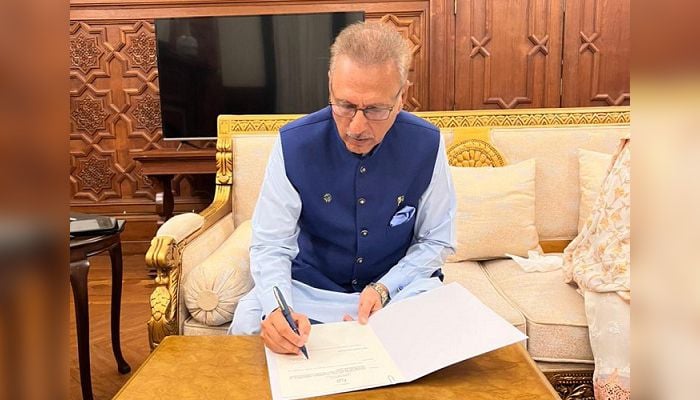
Pakistan's president dissolved the National Assembly on the advice of the prime minister. Twitter Photo
Amid political turmoil and an ongoing economic crisis,
Pakistan's President Arif Alvi on Wednesday dissolved the National Assembly
three days before the completion of its five-year tenure.
The dissolution came on the recommendation of Prime Minister
Shehbaz Sharif, setting the stage for a general election, reports Dawn. It has
paved the way for a caretaker government to oversee elections in which former
prime minister Imran Khan will be unable to participate.
A statement issued by the Presidency just before midnight
read, “President Arif Alvi has dissolved the National Assembly under Article
58(1) on the advice of the prime minister.” After the approval of the summary,
the federal cabinet also stands dissolved.
Addressing the federal cabinet, PM Shehbaz confirmed that
Wednesday was his government’s last day in power. The PM said the coalition
government sacrificed their political capital for the sake of the country as
they had a “gigantic task to save the motherland from looming default”. After
the cabinet meeting, he went to the Parliament House to address the National
Assembly.
On the other hand, the government failed to name the
caretaker prime minister as the premier and leader of the opposition in the
National Assembly Raja Riaz could not meet for this purpose — a constitutional
requirement. Both will meet Thursday as under the Constitution, they have three
days after the dissolution of the assemblies to finalise the name of the
caretaker prime minister.
Who will be caretaker PM?
On the other hand, the ruling parties refrained from
revealing the name of the caretaker prime minister who would spearhead the
interim set-up till general elections, which are likely to be delayed after the
notification of the latest census.
A key meeting between the PM and National Assembly
Opposition Leader Raja Riaz is expected to be held Thursday. Speaking on the
floor of the National Assembly, the premier said he will meet the opposition
leader today to evolve a consensus on the name of the interim PM.
According to Shehbaz, they will have three days to decide on
the matter after the dissolution of the assembly.
In case there was no agreement on any name, the matter would
be referred to a parliamentary committee. If the committee failed to make any
decision, then the Election Commission of Pakistan (ECP) will have two days to
choose the caretaker prime minister from the list of names shared with the
commission.
Soon after the National Assembly’s late-night dissolution,
troops were seen at different points in Islamabad. It wasn’t immediately clear
whether the soldiers’ presence was because of security reasons or VIP movement.
What next for Pakistan, and Imran Khan?
According to reports, the Pakistani government is
considering postponing the elections, as it struggles to stymie security and
political challenges that threaten to destabilise an already cash-strapped
country.
The instability in Pakistan has also put the United States
on alert, reports NDTV.
"We're obviously concerned about any actions – particularly
violent actions – that can contribute to instability in Pakistan or, frankly,
any other country with whom we share a set of common interests when it comes to
counterterrorism," said White House official John Kirby said, as quoted by
news agency AFP.
Imran Khan's Pakistan Tehreek-e-Insaf (PTI) won the most
seats in the last general elections held in the country in 2018. The former
cricket star was sworn in as prime minister three days later.
With general elections looming again, Pakistan's military,
which has staged at least three successful coups since 1947, once again casts
its shadow across the strife-torn country.
Experts believe that Khan's popularity, and his ouster, both
were largely influenced by the military with whom he fell out routinely. The
former Pakistan cricket captain ran a campaign of dissent against the military,
alleging that the military had interfered in politics. He even accused an
intelligence officer as the "mastermind" of an assassination attempt
on him in November during which he was shot in the leg.
Despite staging protests for early elections and pulling his
PTI lawmakers from the parliament, Khan's crusade against the military
ultimately went kaput as he was slapped with over 200 cases.
/KN/

