Mohamed Al-Fayed, billionaire whose son died with Princess Diana, dead at 94
Online Desk
02 Sep 2023 08:55 AM
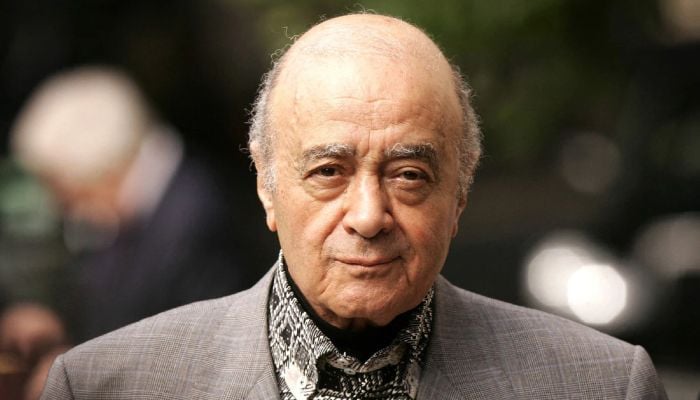
Al-Fayed died on Wednesday - a day before his son and Princess Diana's 26th death anniversary. AFP photo
Mohamed al-Fayed, the self-made Egyptian billionaire who
bought the Harrods department store and promoted the discredited conspiracy
theory that the British royal family was behind the death of his son and
Princess Diana, has died, his family said.
Born in the Egyptian city of Alexandria, al-Fayed began his
career selling fizzy drinks and then worked as a sewing machine salesman. He
built his family's fortune in real estate, shipping, and construction, first in
the Middle East and then in Europe, reports NDTV.
Although al-Fayed owned establishment symbols such as
Harrods, Fulham, and the Ritz hotel in Paris, he was always an outsider in
Britain, tolerated but not embraced.
He fell out with the British government over its refusal to
grant him citizenship of the country that was his home for decades and often
threatened to move to France, which gave him the Legion of Honour, its highest
civilian award.
Al-Fayed - who could be charming, autocratic, vindictive,
and at times wildly outspoken - spent 10 years trying to prove Diana and his
son Dodi were murdered when their car crashed in a road tunnel in Paris in 1997
as they tried to outrun paparazzi photographers on motorbikes.
Unsupported by any evidence, according to the inquest into
Diana's death, he claimed that she was bearing Dodi's child and accused Prince
Philip, the queen's husband, of ordering Britain's security services to kill
her to stop her from marrying a Muslim and having his baby.
Al-Fayed died on Wednesday, his family said, a day before
the 26th anniversary of Dodi and Diana's death.
"Mrs Mohamed Al Fayed, her children and grandchildren
wish to confirm that her beloved husband, their father and their grandfather,
Mohamed, has passed away peacefully of old age," the family statement
read.
While al-Fayed was known for self-invention, exaggeration,
and boasting, he was also a central figure in key moments in Britain's recent
history.
His rancorous takeover of Harrods in 1985 sparked one of
Britain's most bitter business feuds, while in 1994 he caused a scandal with
the disclosure that he had paid politicians to ask questions on his behalf in
parliament.
Like many billionaires, al-Fayed spurned convention. He once
said he wanted to be mummified in a golden sarcophagus in a glass pyramid on
the roof of Harrods.
At the store, where he instituted a dress code - even for
customers - which he enforced in person, he installed a kitsch bronze memorial
statue of Diana and Dodi dancing beneath the wings of an albatross.
As the owner of Fulham, he erected a larger-than-life,
sequined statue of Michael Jackson outside the ground even though the singer
only attended one match. When people complained, he said: "If some stupid
fans don't understand or appreciate such a gift, they can go to hell."
Harrods takeover
Much of al-Fayed's past remained murky - even his date of
birth. He said he was born in then British-ruled Egypt in 1933. However, a
British government inquiry into the Harrods takeover said 1929.
Al-Fayed became a resident in Britain in 1974 and added the
al to his name. Casting this as self-aggrandisement, the satirical magazine
Private Eye nicknamed him the "Phoney Pharaoh".
In 1985 he and his brothers beat businessman Roland
"Tiny" Rowland to Harrods, one of the most famous shops in the world.
Al-Fayed hoped that buying the store would win him
acceptance in British society. Instead, it led to a series of bitter
confrontations.
Rowland took al-Fayed and his brothers to a Department of
Trade inquiry, claiming that they had misrepresented their wealth.
The inquiry cast doubt on their origins as part of a wealthy
business family, past business connections, and their independent financial
resources.
After a quarter of a century of ownership, al-Fayed sold
Harrods to Qatar's sovereign wealth fund in 2010.
Al-Fayed's application for British citizenship was denied by
the government in 1995. He said racism kept him on the fringe of acceptability.
A year earlier, al-Fayed had embarrassed the government by
disclosing that he had made gifts and payments to politicians in return for
them asking parliamentary questions for him. The so-called
"cash-for-questions" scandal ended the careers of four politicians,
including one minister.
The allegations of sleaze undermined the Conservatives, who
lost a landslide election to Labour leader Tony Blair in 1997.
Diana and Dodi
That summer, al-Fayed's son Dodi began a relationship with
Princess Diana, who had divorced Prince Charles, the heir to the British
throne. Dodi and Diana were pictured by British tabloids on holiday on a yacht
in the south of France.
After travelling to Paris, the couple was killed when their
Mercedes, driven at high speed by a chauffeur who had been drinking whisky and
was trying to evade the paparazzi, crashed into a concrete pillar in the Pont
de l'Alma tunnel.
Beset by grief and an overwhelming sense of injustice,
al-Fayed spent millions on legal battles to ensure there was an inquest.
When it started in London a decade after the crash, al-Fayed
would accuse everyone from the royal family, Prime Minister Blair, Diana's
sister Sarah, the French embalmers of Diana's body, and the Paris ambulance
drivers of being implicated.
But the jury said the couple were unlawfully killed by their
chauffeur's driving. Al-Fayed said he accepted the verdict and gave up legal
attempts to show they were murdered.
"I'm leaving the rest for God to get my revenge,"
he said.
/KN/

