Child labour at 'critical moment' as more pushed into work: ILO
Online Desk
04 Sep 2023 08:43 AM
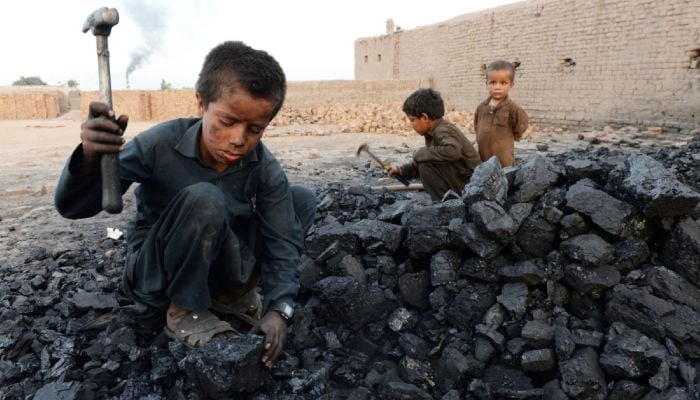
Afghan children working in a coal mine. AFP File Photo
The future of millions of children is at risk as growing
numbers are pulled out of school and into work, the head of the United Nations'
labour body has told the BBC.
Gilbert Houngbo, director-general of the International
Labour Organization (ILO), said there had been a "regression" in
regions around the world amid global economic problems.
Some of the worst forms of work involved sexual
exploitation.
He said urgent action was needed.
"Compound the Covid effect with the rise in inflation
and the cost of living that followed [and] it has just made things worse,"
he said. "Unless we act now and we act decisively and fast, the problem
will [continue to] worsen."
Data compiled by the UN in early 2020 found that some 160
million children were being subjected to child labour, and that global progress
to end it had stalled for the first time in 20 years. Houngbo, the former prime
minister of Togo, said early data suggested the trend was continuing.
He said a squeeze on living costs - driven in part by rising
food and energy prices caused by the war in Ukraine - had for some families
"made the difference between having one meal a day or not". In some
cases this had led to the "worst form of child labour", where parents
were pushing their children into sex work to help support their families.
In the coastal city of Mombasa in south-eastern Kenya, one
14-year-old girl told the BBC she had no choice but to look for work as her
mother struggled to afford food and school fees for her and her two siblings.
To make money, she said she had been "sleeping with
men, washing clothes and plaiting hair".
When she does attend school, she said she sometimes feels so
hungry that she "can't get the pen to write".
Speaking from their small home, her mother said it was
"not easy to tell a child to do something like that".
But she said she was unable to support her family after
losing her job during the pandemic, and now struggled to make ends meet washing
clothes.
"It is very heart breaking. I would like my child to go
to school like other children so that she can get a good job that will help her
in the future, but because I don't have any means she is forced to do that
job."
A woman running a nearby brothel said her business was
"thriving" as she was getting more and more young girls desperate for
money.
Houngbo said the rise in child labour was being seen in low-
middle- and high-income countries, and in sectors including agriculture, mining
and construction.
"Clearly we are in a critical moment," he said,
adding that "poverty is the root cause".
The exact circumstances in different countries vary, but the
UN children's fund (Unicef) says inflation and the rising cost of living are a
"universal concern" that impacts children in a range of ways.
"Many families out of desperation need to resort to
really impossible choices and negative coping strategies that are affecting
children now and in the long-term," said Natalia Winder-Rossi, director of
Unicef's social policy and social protection programme.
The BBC has visited several countries to see how economic
problems are affecting children.
In the southern Lebanese city of Sidon, children said they
had dropped out of school to support their families.
"When I was at school I used to dream of becoming a
teacher. [Now] I stopped dreaming," 14-year-old Alaa, who works cleaning
people's houses, told the BBC.
Unicef says more than one in 10 families in Lebanon send
their children to work. The country is facing an almost total collapse of its
economy.
"I would like to go to school of course, but in this
situation who would think of going to school? You need to provide for your
family. I'm suffocating... but I have to put up with it," said 15-year-old
Muhammad, who sells tissues in the road to passing cars.
But Houngbo said that while the situation was "very
worrisome", he remained optimistic that solutions could be found.
He said there was no "one size fits all approach",
but policies focusing on education, creating jobs, and cracking down on illicit
industries were among the actions that could be taken.
Governments needed to "step up now", he said.
/KN/

