Death count in Morocco earthquake rises to 2,122
AFP
11 Sep 2023 11:23 AM
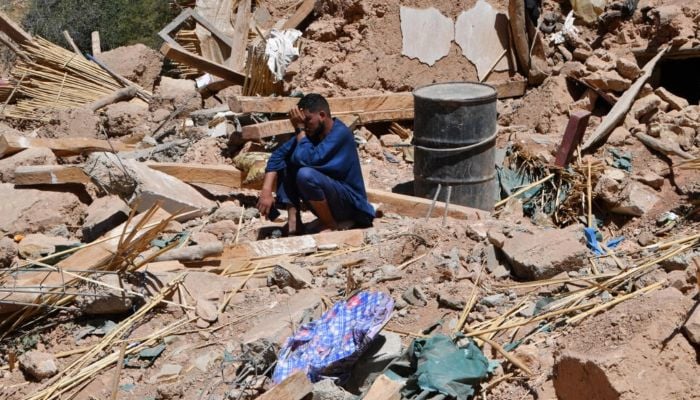
The village of Tikht near the epicentre of Morocco's massive earthquake was effectively destroyed. AFP Photo
Using heavy equipment and even their bare hands, rescuers in
Morocco on Sunday stepped up efforts to find survivors of a devastating
earthquake that killed more than 2,100 people and flattened villages.
The first foreign rescuers flew in to help after the North
African country's strongest-ever quake killed at least 2,122 people and injured
more than 2,400, many seriously, according to official figures updated late on
Sunday.
Friday's 6.8-magnitude quake struck 72 kilometres (45 miles)
southwest of the tourist hub of Marrakesh, wiping out entire villages in the
hills of the Atlas mountains.
On Sunday an aftershock of magnitude 4.5 rattled
already-traumatised residents in the same region.
The mountain village of Tafeghaghte, 60 kilometres from
Marrakesh, was almost entirely destroyed, an AFP team reported, with very few
buildings still standing.
Amid the debris, civilian rescuers and members of Morocco's
armed forces searched for survivors and the bodies of the dead.
AFP saw them recover one body from the ruins of a house.
Four others were still buried there, residents said.
"Everyone is gone! My heart is broken. I am
inconsolable," cried Zahra Benbrik, 62, who said she had lost 18
relatives, with only the body of her brother still trapped.
"I want them to hurry and get him out so I can mourn in
peace," she said.
Many houses in remote mountain villages were built from mud
bricks.
In the village of Amizmiz, near Tafeghaghte, a backhoe
dragged away the heaviest pieces of rubble before rescuers dug into the dusty
debris with their bare hands to remove a body that appeared to be under a
quilt.
The crucial hours
The two villages lie in Al-Haouz province, site of the
epicentre, which suffered the most deaths, 1,351, authorities reported.
According to Moroccan public television, "more than
18,000 families have been affected" by the quake in Al-Haouz.
Citizens on Sunday rushed to hospitals in Marrakesh to
donate blood to help the injured.
Spain's defence ministry said an A400 airlifter took off
from Zaragoza with 56 rescuers and four search dogs headed for Marrakesh to
"help in the search and rescue of survivors".
"We will send whatever is needed because everyone knows
that these first hours are key, especially if there are people buried under
rubble," Defence Minister Margarita Robles told Spanish public television.
Many residents of the usually bustling tourist hotspot of
Marrakesh spent a second night sleeping on the streets, huddled together under
blankets and among bags filled with their belongings.
One of them, Fatema Satir, said many stayed outside for fear
of their houses collapsing.
"There is no help for us," Satir said. "Our
houses have been cracked, others destroyed – like my daughter's house which was
wiped out. We are in a chaotic state."
In the city's historic Jemaa el-Fna square, about 20 people
were huddled on the ground, wrapped in blankets, while others stayed on the
lawn of the nearby town hall, its 12th-century ramparts partially collapsed.
The kingdom declared three days of national mourning, and a
prayer for the quake victims was to be held Sunday in all of the kingdom's
mosques.
Morocco's interior ministry said on Saturday evening that
authorities are "mobilised to speed up rescue operations and evacuate the
injured."
In addition to Spain, several countries offered aid.
French President Emmanuel Macron said his country has
mobilised "all technical and security teams to be able to intervene, when
the Moroccan authorities deem it useful."
Macron, along with Indian Prime Minister Narendra Modi and
the heads of the World Bank, International Monetary Fund, African Union and
European Commission, also pledged, in a joint statement, to "mobilise our
technical and financial tools and assistance" to help the people of
Morocco.
Long recovery ahead
The United States said it also had search-and-rescue teams
ready to deploy, and Pope Francis on Sunday again expressed support for those
affected by the disaster.
"I thank the rescuers and all those who are working to
alleviate the suffering of the people," he said from the Vatican window
above St Peter's Square.
Algeria, which has long had tense relations with
neighbouring Morocco, opened its airspace, which had been closed for two years,
to flights carrying humanitarian aid and evacuating the injured.
Israeli Prime Minister Benjamin Netanyahu, whose country in
2020 established ties with Morocco, offered to send search-and-rescue teams,
declaring that "Israel stands by Morocco in its difficult time".
The Red Cross warned that it could take years to repair the
damage.
"It won't be a matter of a week or two... We are
counting on a response that will take months, if not years," said Hossam
Elsharkawi, its Middle East and North Africa director.
The quake was the deadliest in Morocco since a 1960
earthquake destroyed Agadir and killed more than 12,000 people.
/KN/

