Libya death toll estimated at 11,300
AFP
17 Sep 2023 10:44 AM
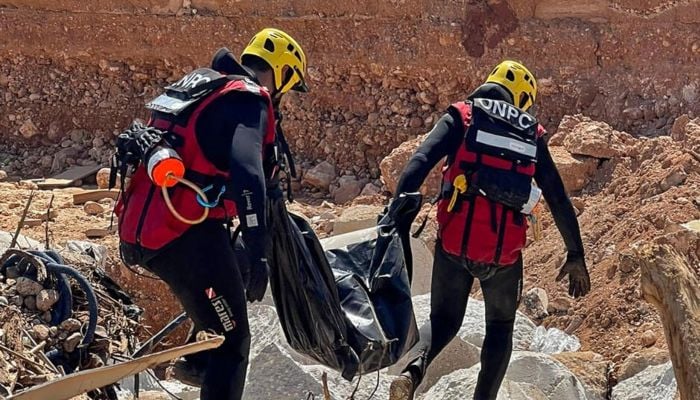
Tunisian emergency teams recover a body during relief work in Libya's devastated city of Derna. AFP Photo
A week after a wall of water rushed through the Libyan
coastal city of Derna, sweeping thousands to their deaths, the focus turned
Sunday to caring for survivors of the disaster.
Estimates of the number of lives lost vary widely.
The most recent official death toll, from the health
minister of the eastern-based administration, Othman Abdeljalil, is that 3,166
people were killed.
But according to a United Nations report released on Sunday,
the toll from Derna alone has risen to 11,300.
Citing the Libyan Red Crescent, the UN Office for the
Coordination of Humanitarian Affairs added that another 10,100 people were
still missing in the devastated city.
"These figures are expected to rise in the coming days
and weeks as search-and-rescue crews work tirelessly to find survivors,"
the OCHA report said.
Aid is now arriving in the North African country as the
world mobilises to help emergency services cope with the aftermath of the
deadly flood.
At least 40,000 people have been displaced across
northeastern Libya, according to the International Organization for Migration,
which cautioned the actual number is likely higher given the difficulty
accessing the worst-affected areas.
Two dams upstream from Derna burst a week ago under the
pressure of torrential rains from the hurricane-strength Storm Daniel.
The dams had been built to protect the port city of 100,000
people after it was hit by significant flooding in the mid-20th century.
The banks of a dried riverbed or wadi running through the
city centre had been heavily built on, and last week's torrent swept everything
before it as it rushed towards the Mediterranean.
A week on, bodies are still being found.
A rescue crew from Malta's Civil Protection Department
discovered a beach strewn with dead bodies on Friday, the Times of Malta
newspaper reported.
International aid is arriving from the United Nations,
Europe and the Middle East, offering some relief to the thousands of survivors.
The aid includes essential medicines and emergency surgical
supplies, as well as body bags to allow corpses to be moved.
Tents, blankets, carpets, hygiene kits and food have been
flown in, along with heavy machinery to help clear the debris.
Questions being asked
The devastating flooding brought by Storm Daniel was
exacerbated by poor infrastructure in Libya, which was plunged into turmoil
after a NATO-backed uprising toppled and killed longtime dictator Moamer
Kadhafi in 2011.
Questions are being asked as to why the disaster was not
prevented, when cracks in the dams have been known about since 1998.
Prosecutor general Al-Seddik Al-Sour has announced an
investigation into the circumstances leading to the collapse.
Like much of Libya's crumbling infrastructure, the two dams
that had been built to hold back water from Derna fell into disrepair during
years of neglect, conflict and division in chaos-ridden Libya.
The country is currently ruled by two rival administrations
that have battled for power since Kadhafi's ousting.
With tens of thousands of people displaced, aid
organisations have warned of the risks posed by leftover landmines and other
unexploded ordnance, some of which the UN said has been shifted by floodwaters
into areas previously declared clear.
The risks of water-borne diseases such as cholera are also
high, according to aid groups.
Outside Derna, the flooding took an additional 170 lives,
the UN's report said.
The National Centre for Disease Control reported that at
least 55 children were poisoned as a result of drinking polluted water in
Derna.
To assist the hundreds of thousands of people in need, the
UN has launched an appeal for more than $71 million.
"We don't know the extent of the problem," UN aid
chief Martin Griffiths said on Friday, as he called for coordination between
Libya's two rival administrations – the UN-backed, internationally recognised
government in Tripoli, and one based in the disaster-hit east.
The scale of the devastation has prompted shows of
solidarity, as volunteers in Tripoli gathered aid for the flood victims.
Survivors in Derna are glad to be alive, even as they mourn
the loss of loved ones.
"In this city, every single family has been
affected," said Derna resident Mohammad al-Dawali.
Seir Mohammed Seir, a member of the security forces, spoke
of a three-month-old girl who lived through the tragedy in Derna.
"Her entire family died, she was the only one who
survived."
/KN/

