Trudeau faces cold reality
Online Desk
24 Sep 2023 15:38 PM
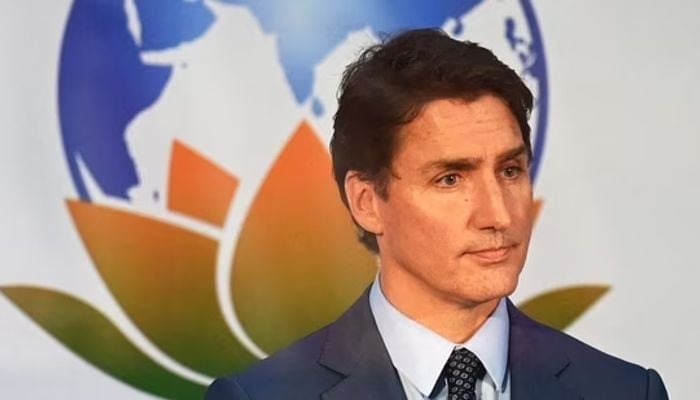
Canadian Prime Minister Justin Trudeau. AFP File Photo
This week in New York, as he listened to questions from
reporters, Canadian Prime Minister Justin Trudeau's reliable smile began to
fade, reports BBC.
Unsurprisingly, nearly all the questions were about India and
the shocking allegation made by Trudeau earlier in the week: there was credible
evidence the Indian government had participated in the extrajudicial killing of
a Canadian citizen on Canadian soil, a Sikh activist whom India has accused of
terrorism.
Delhi has denied having anything to do with the murder.
Speaking slowly, carefully, the prime minister stuck closely
to his talking points. "We're not looking to provoke or cause
problems," he said. "We're standing up for the rules-based
order."
But where, several reporters asked, were Canada's allies?
"So far in time," one journalist said to Trudeau, "you seem to
be alone".
In the public eye at least, Trudeau has appeared to be left
largely on his own as he goes toe to toe with India, one of the world's fastest-growing
economies, with a population 35 times bigger than Canada's.
In the days since the prime minister made the explosive
announcement, his allies in the Five Eyes intelligence alliance provided
seemingly boilerplate public statements, all stopping far short of
full-throated support.
UK Foreign Secretary James Cleverly said his country took
"very seriously the things that Canada are saying". Using nearly
identical language, Australia said it was "deeply concerned" by the
accusations.
But perhaps the most deafening silence came from Canada's
southern neighbour, the United States. The two countries are close allies, but
the US did not speak up with outrage on Canada's behalf.
When President Joe Biden publicly raised India this week,
while speaking at the UN, it was not to condemn, but to praise the country for
helping to establish a new economic pathway.
Biden's National Security Adviser Jake Sullivan later denied
that there was a "wedge" between the US and its neighbour, saying
Canada was being closely consulted. But other public statements were tepid,
more nods to "deep concern", coupled with affirmations of India's
growing importance to the Western world.
The problem for Canada, experts told the BBC, is that its
interests currently pale in comparison to India's massive strategic importance.
"The United States, the UK, and all these Western and
Indo-Pacific allies have built a strategy that largely focuses on India, to be
a bulwark and counterweight to China. That's something they can't afford to
toss out the window," said Xavier Delgado, a researcher at the Wilson
Center's Canada Institute.
"The fact that they haven't come out and rushed to
Canada's defence is indicative of the geopolitical reality."
Speaking to Canadian network CTV, US Ambassador to Canada
David Cohen confirmed reports that the Five Eyes partners had shared
intelligence on the matter. But on a report that those same allies had rebuffed
an appeal from Canada to publicly condemn the murder he said only that he was
"not in the habit of commenting on private diplomatic conversations".
Still, the relative quiet may also be indicative of Canada's
shortcomings on the world stage - a dependable Western ally, but not a global
power in its own right.
"This is a moment of weakness," said Christopher Sands,
director of the Canada Institute.
"Right now we're seeing a hard power moment. That is
not the environment where Canada shines," he said. "The decisive
stuff is all force, power and money, which Canada doesn't have."
Few outside India took issue with Trudeau's decision to
publicly disclose the allegations which, if true, would amount to a political
assassination on Canadian soil at the hands of a fellow democracy. But those
ethics may not be enough to shift global headwinds.
For Trudeau, that cold geopolitical reality meant an
apparently solitary few days while the tensions with India dialled up higher
and higher - diplomatic expulsions, travel advisories and, most dramatically, a
suspension of all visa services for Canadians seeking to travel to India.
To add insult to injury, this long week comes at the end of
an even longer summer for Canada's Liberal leader.
As Canadians struggled with inflation and high interest
rates, news broke of alleged Chinese interference in Canadian elections, which
critics said Trudeau and his cabinet were aware of, but failed to take
seriously.
Then it came out that the country's most notorious serial
killer Paul Bernardo was being transferred to a medium-security prison,
inspiring country-wide outrage. Once again, Trudeau's team faced criticism that
it had been caught flat-footed.
By September, Trudeau's approval ratings had dropped to a
three-year low, with 63% of Canadians disapproving of their prime minister, who
was elected in 2015.
"He's not been lower than that over an eight-year
period," said Shachi Kurl, president of Angus Reid Institute, a
non-partisan research group. "There were questions being put to him very
squarely, like 'are you going to stick around? Will you resign?'"
It's another cold reality for Trudeau, who started in the
prime minister's office as a minor national star, with a sweeping majority
mandate.
"He's a celebrity like we've never seen in Canadian
politics," said Campbell Clark, chief political writer for the Globe and
Mail newspaper. "And after he won the election, his popularity
soared."
But after eight years of a highly visible prime minister,
Canadians may have had their fill, Clark said, noting it feels like Trudeau's
star power has faded, especially in recent months.
Still, some experts cautioned that while Trudeau may seem to
be standing alone on the international stage, this row with India may provide a
much-needed bump at home.
"It got him away from all of these domestic
questions," Clark said.
And it can't have hurt that Trudeau finished his week
standing side by side with another ally - and an even bigger celebrity -
Ukrainian President Volodymyr Zelensky. For a day, at least, Trudeau seemed to
be in very good company.
/KN/

