Controversial or safer pick for Nobel literature prize?
AFP
05 Oct 2023 11:15 AM
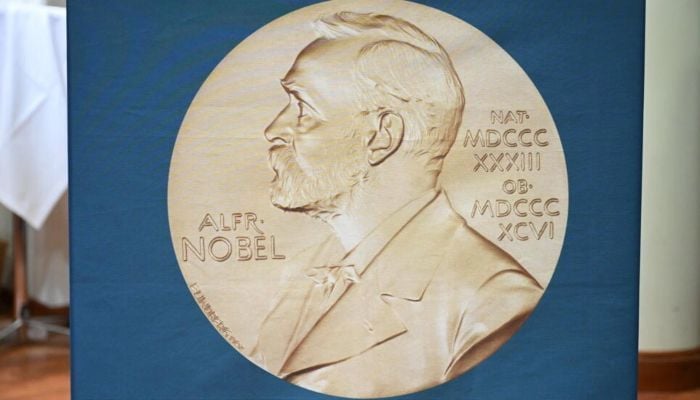
The Nobel Prize in Literature – to be announced Thursday – could go to an overtly political author like a Kremlin critic, or crown a safer or lesser-known writer, experts say.
All the literary gossip and wild guessing of the last few
weeks will have their answer on Thursday at 1:00 pm (1100 GMT) when the Swedish
Academy in Stockholm reveals its pick.
Russian author and outspoken Kremlin critic Lyudmila
Ulitskaya, who lives in self-imposed exile in Germany, has been frequently
mentioned in this year's speculation.
Her epic novels, often focused on personal relationships,
have been compared to those of Leo Tolstoy and John Steinbeck. She has harshly
criticised Russian President Vladimir Putin over his "senseless" war
in Ukraine, predicting it will be "catastrophic" for Russia.
Lisa Irenius, culture editor at Swedish daily Svenska
Dagbladet, said it would be a bold choice to champion Russian culture at a time
when Moscow is being lambasted over Ukraine.
But it would also send a message that "literature
stands free from politics", she said.
Betting sites have been surprisingly accurate in predicting
the laureate in recent years, with Norwegian playwright Jon Fosse and China's
avant-garde fiction writer and literary critic Can Xue hotly tipped this year.
But Bjorn Wiman, culture editor at Sweden's paper of
reference Dagens Nyheter, told AFP his favourite was a political author whose
name has featured in Nobel speculation for years: Salman Rushdie.
The Indian-born British author survived a stabbing on stage
last year after living in hiding for years due to an Iranian fatwa calling for
his death over his 1988 book "The Satanic Verses".
"It's time for him to win, and if he does, hats off to
the Academy" for standing up for freedom of expression, which Rushdie
embodies, Wiman said.
Righting a wrong?
A nod to Rushdie would correct what many see as a
three-decade-old mistake made by the 18-member Swedish Academy.
In the name of the "independence of literature",
the Academy refused to condemn the 1989 fatwa against Rushdie.
Academy members were divided about whether to stand as
neutral guarantors of the arts or as supporters of their fellow author. Three
members angered by the Academy's silence resigned. It was not until 2016 that
the Academy finally condemned the fatwa.
With no public shortlist, it is always difficult to predict
which way the Swedish Academy is leaning.
It could, as it has frequently done in the past, shine a
spotlight on a figure less well known to the general public, such as Can Xue or
Fosse, whose work is among the most widely staged of any contemporary
playwright in Europe.
Australia's Gerard Murnane, Kenyan writer Ngugi wa Thiong'o
and Romanian author Mircea Cartarescu are also much fancied.
"It's still very difficult to guess" the winner,
stressed Lina Kalmteg, literary critic for Swedish public radio SR. As is the
case for all Nobel prizes, the list of nominations and the juries' deliberations
are sealed for 50 years.
Reflect the times
Other "usual suspects" frequently mentioned in the
speculation are Hungary's Peter Nadas and Laszlo Krasznahorkai, Albania's
Ismail Kadare, Canada's Margaret Atwood and Somali author Nuruddin Farah.
The Swedish Academy – made up of authors, historians, philosophers
and linguists – has long been criticised for the overrepresentation of Western white
male authors among its picks.
Since the Academy was torn apart by a 2018 #MeToo scandal,
followed by its controversial pick of Austrian author Peter Handke for the 2019
Nobel, the body has tried to turn the page.
Last year it gave the prestigious award to French feminist
icon Annie Ernaux. The year before it honoured British Tanzanian-born writer
Abdulrazak Gurnah for his work exploring the torments of exile, colonialism and
racism.
"In recent years, there is more awareness that you
can't remain in a eurocentric perspective, there has to be more equality and
the prize has to reflect the times," Stockholm University literature
professor Carin Franzen told AFP.
She would like to see the prize go to Canadian poet Anne
Carson.
/KN/

