China prepares for summit under shadow of Israel-Gaza war
AFP
16 Oct 2023 12:45 PM
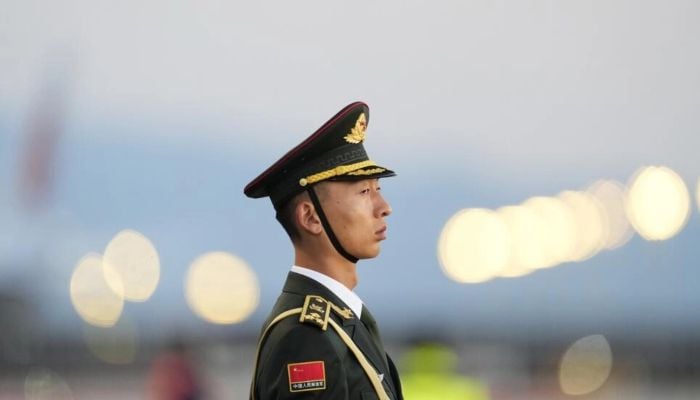
A guard honor stands at Beijing Capital International Airport. AFP Photo
China prepared on Monday to host representatives of 130
countries for a forum that will be overshadowed by the Israel-Gaza war, as an
increasingly assertive Beijing is asked to help de-escalate the violence.
At the top of the invite list to China's Belt and Road
Initiative (BRI) forum is Russia's President Vladimir Putin, on his first trip
to a major global power since the Ukraine invasion threw his regime into
international isolation.
Leaders have begun to trickle into the Chinese capital for a
gala event marking a decade of the BRI -- a key project of President Xi Jinping
to extend China's global reach.
While China hopes the forum will help boost its standing as
a leading global power, Israel's war with Palestinian militant organisation
Hamas will continue to dominate the headlines.
Israel declared war on the Islamist group after waves of its
fighters broke through the heavily fortified border on October 7, shooting,
stabbing and burning to death more than 1,400 people, most of them civilians.
Under heavy Israeli bombardment of the Hamas-ruled Gaza
Strip, more than one million people have fled their homes in scenes of chaos
and despair.
Israel's bombing has left at least 2,670 people dead in
Gaza, mainly civilians, and flattened entire neighbourhoods.
China's Foreign Minister Wang Yi has condemned Israel's
actions for going "beyond the scope of self-defence" and called for
it to "cease its collective punishment of the people of Gaza".
"(Israel) should listen earnestly to the calls of the
international community and the UN secretary general, and cease its collective
punishment of the people of Gaza," Wang said Sunday, in what is the
strongest stance China has expressed so far on the conflict.
Beijing has been criticised by Western officials for not
specifically naming Hamas in its statements on the Israel-Gaza conflict.
Wang had on Sunday spoken with US Secretary of State Antony
Blinken, who called on China to use its "influence" in the Middle
East to push for calm.
China has a warm relationship with Iran, whose clerical
leadership supports both Hamas and Hezbollah, the Lebanese militant group that
could open a second front against Israel.
Earlier this year, China brokered an entente between former
regional foes Iran and Saudi Arabia.
Beijing's special envoy Zhai Jun will visit the Middle East
this week to push for a ceasefire in the Israel-Hamas conflict and promote
peace talks, China's state broadcaster CCTV said on Sunday, without specifying
which countries he would visit.
Niva Yau, a nonresident fellow with the Atlantic Council's
Global China Hub, told AFP the BRI summit would allow Beijing to frame
attendance as a gesture of support for its position.
"Any head of state that attends the summit, it's almost
as if they agree with Beijing's positions on these global issues," she
said.
Strategic dependence
A number of leaders have already arrived in Beijing ahead of
the two-day forum, which kicks off Tuesday.
Among them are Hungarian Prime Minister Viktor Orban,
Chilean President Gabriel Boric, Kenyan President William Ruto and Ethiopian
Prime Minister Abiy Ahmed.
On Monday Russia's top diplomat Sergei Lavrov flew into
Beijing and within hours held talks with China's Foreign Minister Wang Yi.
Putin – whose strategic dependence on China has only grown
since his invasion of neighbouring Ukraine thrust his country into
international isolation – is expected to arrive overnight.
This year, trade between China and Russia has soared to
levels not seen since the beginning of Moscow's war in Ukraine, with Chinese
imports of Russian oil offering Moscow a critical lifeline as international
sanctions bite.
China has refused to condemn the Ukraine war in an effort to
position itself as a neutral party, while at the same time offering Moscow
vital diplomatic and financial support.
At the heart of the deepening partnership is the
relationship between Xi and Putin, who have described each other as "dear
friends".
Their alliance is also forged by a symbiotic necessity, each
seeing the other as a necessary bulwark in their shared struggle against
Western dominance.
In an interview with Chinese state broadcaster CGTN ahead of
his visit this week, Putin hailed ties with Beijing and the "mutual
benefits" of the BRI.
"President Putin pointed out that a multipolar world is
taking shape, and the concepts and initiatives put forward by President Xi
Jinping are highly relevant and significant," CGTN reported.
"He stated that President Xi Jinping is a
well-recognised leader on the world stage and is a true world leader," it
said.
Putin also reportedly "shared pleasant memories between
President Xi and him, and hoped tradition continues when they meet in China in
the future."
/KN/

