Jailed Iranian Nobel winner begins hunger strike
AFP
07 Nov 2023 11:10 AM
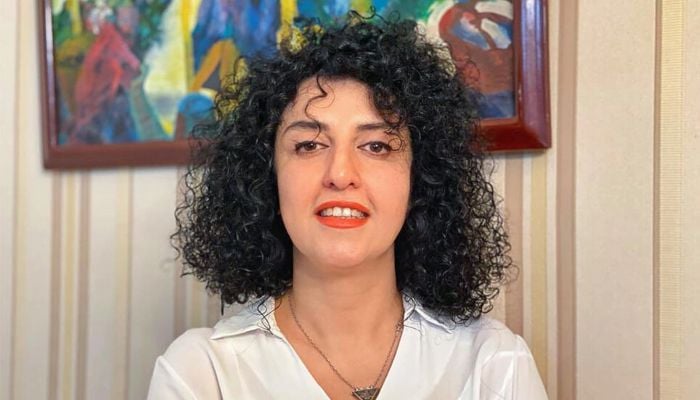
Nobel Peace Prize winner Narges Mohammadi has begun a hunger
strike in her Iranian prison in protest at limits on medical care for her and
other inmates, as well as the obligation for women to wear the hijab in the
Islamic republic, her family said on Monday.
Veteran rights activist Mohammadi, 51, currently held in
Tehran's Evin prison, was awarded the Nobel prize in October "for her
fight against the oppression of women in Iran".
"Narges Mohammadi, today, through a message from Evin
Prison, has informed her family that she started a hunger strike several hours
ago. We are concerned about Narges Mohammadi's physical condition and
health," her family said in a statement.
Mohammadi is refusing under any circumstances to wear a
hijab, the head covering which has been obligatory for women in public spaces
since shortly after Iran's 1979 Islamic revolution.
Prison authorities in response have refused to transfer
Mohammadi, who suffers from heart and lung conditions, to a hospital outside
Evin for treatment.
The family said in the statement that she was in
"urgent" need of medical treatment outside prison.
"Narges went on a hunger strike today in protesting two
things: The Islamic Republic's policy of delaying and neglecting medical care
for sick inmates... (and) the policy of 'mandatory hijab' for Iranian
women," the statement said.
"The Islamic republic is responsible for anything that
happens to our beloved Narges," it said. "It's been a week now that
they are refusing to give her the medical aid she needs."
'Morally unacceptable'
In a strong statement of support for Mohammadi, the Chair of
the Norwegian Nobel Committee, Berit Reiss-Andersen, said the committee was
"deeply concerned" about the 2023 laureate's health.
"The requirement that female inmates must wear a hijab
in order to be hospitalised is inhumane and morally unacceptable," she
said.
"Narges Mohammadi's initiation of a hunger strike
demonstrates the seriousness of the situation. The Norwegian Nobel Committee
urges the Iranian authorities to provide Narges Mohammadi, and other female
inmates, with whatever medical assistance they may need," she added.
Pen International, a group promoting freedom of expression,
meanwhile said it was "gravely concerned" about Mohammadi's health
condition and "holds Iranian authorities fully responsible for putting her
life at critical risk."
"Narges Mohammadi should not be in jail in the first
place," it added, saying Iran should "immediately" release her
and "urgently transfer her to a hospital to receive medical
treatment."
'Means of repression'
First arrested 22 years ago, Mohammadi has spent much of the
past two decades in and out of jail over her campaigning for human rights in
Iran.
She has most recently been incarcerated since November 2021
and has not seen her children, now based in France, for eight years.
Mohammadi's Nobel came in the wake of months-long protests
across Iran triggered by the September 2022 death in custody of Mahsa Amini,
22, who had been arrested for allegedly flouting the Islamic republic's strict
dress rules for women.
From prison, Mohammadi has also expressed outrage over what
she described as the "murder" of 17-year-old Armita Garawand who died
in October after a month in a coma following an incident on the Tehran metro.
Activists say Garawand died after being beaten by the Tehran
morality police for not wearing a headscarf, which has been vehemently denied
by the authorities.
In a message expressing gratitude for the prize, read by her
daughter and posted on the Nobel website earlier this month, Mohammadi
described the mandatory hijab as a "means of control and repression
imposed on society and on which the continuation and survival of this
authoritarian religious regime depends".
/KN/

