Gaza in spotlight as Arab, Muslim blocs meet in Saudi
AFP
11 Nov 2023 13:59 PM
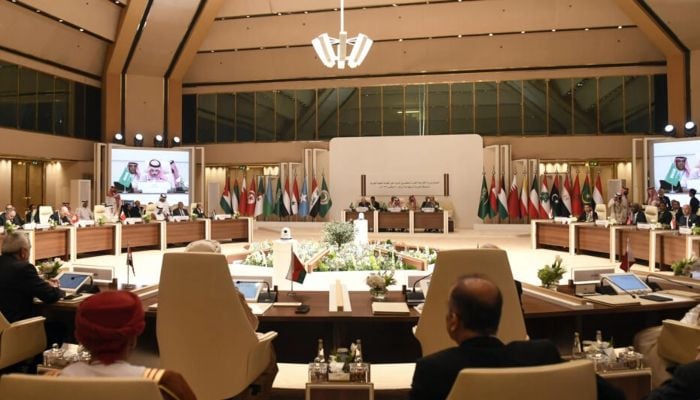
Arab foreign ministers at a preparatory meeting ahead of the extra-ordinary Arab League summit in Riyadh expected to underscore demands that Israel's war in Gaza ends. AFP Photo
Arab leaders and Iran's president are in the Saudi capital
Saturday for a summit meeting expected to underscore demands that Israel's war
in Gaza end before the violence draws in other countries.
The emergency meeting of the Arab League and the
Organisation of Islamic Cooperation (OIC) comes after Hamas militants' bloody
October 7 attacks that Israeli officials say left about 1,200 people dead and
239 taken hostage.
Israel's subsequent aerial and ground offensive has killed
more than 11,000 people, mostly civilians and many of them children, according
to the Hamas-run health ministry.
Aid groups have joined pleas for a ceasefire, warning of a
humanitarian "catastrophe" in Gaza, where food, water and medicine
are in short supply.
The Arab League and the OIC were originally meant to meet
separately, but the Saudi foreign ministry announced early Saturday that the
blocs' summits would be combined.
The move underscores the importance of reaching "a
unified collective position that expresses the common Arab and Islamic will
regarding the dangerous and unprecedented developments witnessed in Gaza and
the Palestinian territories," the official Saudi Press Agency reported.
The Arab League aims to demonstrate "how the Arabs will
move on the international scene to stop the aggression, support Palestine and
its people, condemn the Israeli occupation, and hold it accountable for its
crimes", the bloc's assistant secretary-general, Hossam Zaki, said this
week.
But Palestinian militant group Islamic Jihad on Friday said
it did not "expect anything" from the meeting, criticising Arab
leaders for the delay.
"We are not placing our hopes on such meetings, for we
have seen their results over many years," Mohammad al-Hindi, the group's
deputy secretary-general, told a press conference in Beirut.
"The fact that this conference will be held after 35
days (of war) is an indication of its outcomes."
Israel and its main backer the United States have so far
rebuffed demands for a ceasefire, a position that is expected to draw heavy
criticism on Saturday.
"This is not just about Israel-Palestine – this is
about what is facilitating Israel to do this, which is basically the United
States and the West," said Saudi analyst Aziz Alghashian.
That tension has been on display during US Secretary of
State Antony Blinken's recent visits to the region, as well as during a stop
this week in Riyadh by British Foreign Secretary James Cleverly, who met with a
number of his Arab counterparts who have called for a ceasefire.
"What we have said is that calling for a ceasefire is
understandable, but what we also recognise is that Israel is taking action to
secure its own stability and its own security," Cleverly said on Thursday.
Raisi to Riyadh
Iranian President Ebrahim Raisi's expected attendance on
Saturday will mark his first trip to Saudi Arabia since the two Middle East
heavyweights reached a surprise rapprochement deal in March, ending seven years
of severed ties.
Iran backs Hamas as well as Lebanon's Hezbollah and Yemen's
Huthi rebels, placing it at the centre of concerns the war could expand.
The conflict has already fuelled cross-border exchanges
between the Israeli army and Hezbollah, and the Huthis have claimed
responsibility for "ballistic missiles" the rebels said targeted
southern Israel.
Analysts say Saudi Arabia feels vulnerable to potential
attacks because of its close ties with Washington and the fact that it was
considering normalising ties with Israel before the war broke out.
Saudi Arabia's de facto ruler Crown Prince Mohammed bin
Salman on Friday condemned "continued violations of international
humanitarian law by the Israeli occupation forces," his first public
comments on the war, though Riyadh has levelled similar criticism in multiple
statements.
Kim Ghattas, author of a book on the Iran-Saudi rivalry,
said during a panel organised by the Arab Gulf States Institute in Washington
that "the Saudis are hoping that the fact they didn't normalise yet, and
the fact that they have a channel to the Iranians, gives them some
protection."
She added: "And I think the Iranians are hoping that
the fact that they're in touch with the Saudis and maintaining that channel,
that it gives them some protection too."
/KN/

