Arab, Muslim bloc leaders slam Israel
AFP
12 Nov 2023 11:39 AM
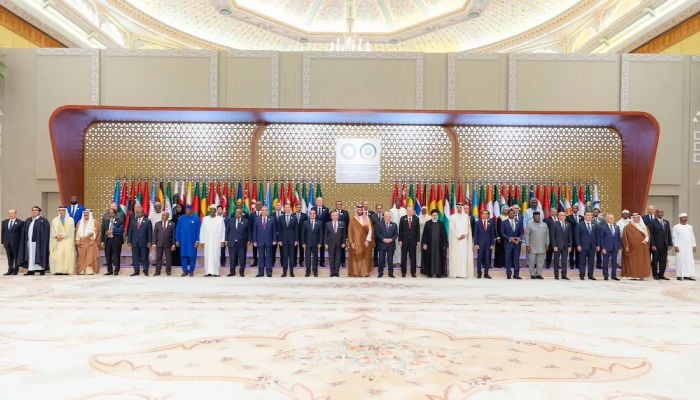
Arab and Muslim leaders on Saturday condemned Israeli
forces' "barbaric" actions in Gaza but declined to approve punitive
economic and political steps against the country over its war against Hamas.
The outcome of a joint summit in the Saudi capital of the
Arab League and the Organisation of Islamic Cooperation highlighted regional
divisions over how to respond to the war even as fears mount that it could draw
in other countries.
The summit took place against a backdrop of widespread anger
in the Middle East and beyond over Israel's aerial and ground offensive in
Gaza, which has killed more than 11,000 people, mostly civilians and many of
them children, according to the Hamas-run health ministry.
Israel says it has set out to destroy Hamas following the
group's bloody October 7 attacks that Israeli officials say killed about 1,200
people, also mostly civilians, and saw about 240 taken hostage.
The final declaration on Saturday rejected Israeli claims
that it is acting in "self-defence" and demanded that the United
Nations Security Council adopt "a decisive and binding resolution" to
halt Israel's "aggression".
It also called for an end to weapons sales to Israel and
dismissed out of hand any future political resolution to the conflict that
would keep Gaza separate from the Israeli-occupied West Bank.
Saudi Arabia's de facto ruler Crown Prince Mohammed bin
Salman, who before the war was considering establishing formal diplomatic ties
with Israel, told the summit he "holds the occupation (Israeli)
authorities responsible for the crimes committed against the Palestinian
people."
Iranian President Ebrahim Raisi, on his first trip to Saudi
Arabia since the two countries mended ties in March, said Islamic nations
should designate the Israeli army a "terrorist organisation" for its
conduct in Gaza.
Israel blames Hamas for the high death count, accusing it of
using civilians as "human shields" – a charge Hamas denies.
Regional divisions
The Arab League and the OIC, a 57-member bloc that includes
Iran, were originally meant to meet separately.
Arab diplomats told AFP the decision to merge the meetings
came after Arab League delegations failed to reach an agreement on a final
statement.
Some countries, including Algeria and Lebanon, proposed
responding to the devastation in Gaza by threatening to disrupt oil supplies to
Israel and its allies as well as severing the economic and diplomatic ties that
some Arab League nations have with Israel, the diplomats said.
However, at least three countries – including the United
Arab Emirates and Bahrain, which normalised ties with Israel in 2020 – rejected
the proposal, according to the diplomats who spoke on condition on anonymity.
In a statement issued from Gaza, Hamas called on summit
participants to expel Israeli ambassadors, form a legal commission to try
"Israeli war criminals" and create a reconstruction fund for the
territory.
Syrian President Bashar al-Assad said a lack of concrete
punitive measures against Israel would render the summit toothless.
"If we do not have real tools for pressure, then any
step we take or speech we give will have no meaning," said Assad, who was
welcomed back into the Arab fold this year after an extended rift over his
country's civil war.
He said no Middle Eastern country should engage in any
"political process" with Israel, including developing economic
relations, until a lasting ceasefire is reached.
The lack of consensus was no big surprise, said Rabha Saif
Allam, a specialist in Middle Eastern affairs at the Cairo Center for Strategic
Studies.
Differences between Washington's Arab allies and countries
closer to Iran "can't be erased overnight," Allam said.
Israel and its main backer the United States have so far
rebuffed demands for a ceasefire, a position that drew heavy criticism on
Saturday.
Turkey's President Recep Tayyip Erdogan said "it is a
shame that Western countries, which always talk about human rights and
freedoms, remain silent in the face of the ongoing massacres in
Palestine".
Prince Faisal bin Farhan, the Saudi foreign minister,
similarly decried "double standards" in the world's response to the
war, saying Israel was getting a pass on violations of international law.
Iran president in Riyadh
Raisi's stop in Riyadh made him the first Iranian president
to set foot in Saudi Arabia since Mahmoud Ahmadinejad attended an OIC meeting
in the kingdom in 2012.
In addition to addressing the summit, he held a face-to-face
meeting with Prince Mohammed, Saudi state media said on X, formerly Twitter.
Iran backs Hamas as well as Lebanon's Hezbollah and Yemen's
Huthi rebels, placing it at the centre of concerns the war could expand.
The conflict has already fuelled cross-border exchanges
between the Israeli army and Hezbollah, and the Huthis have claimed
responsibility for "ballistic missiles" the rebels said targeted
southern Israel.
/KN/

