Surging Israeli settler violence puts West Bank Palestinians on edge
AFP
16 Nov 2023 10:35 AM
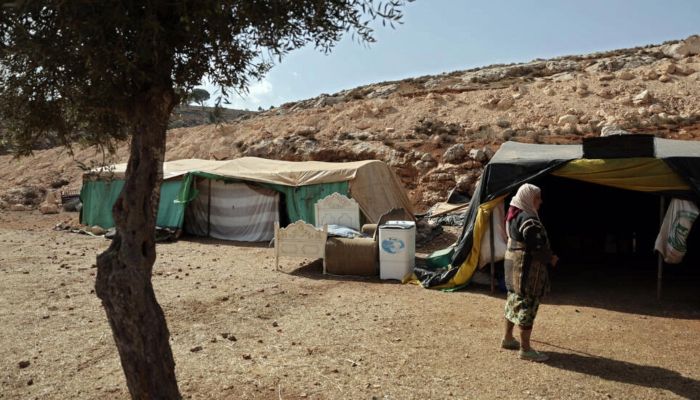
Rural Palestinians in the occupied West Bank say they have faced increased harassment from Israeli settlers since the start of the Israel-Hamas war in Gaza. AFP Photo
Blocked roads, armed raids, sabotaged wells: rural
Palestinians in the occupied West Bank say they have faced increased harassment
from Israeli settlers since the start of the Israel-Hamas war in Gaza.
In Imran Nawaja's village, the access road has been
obstructed by huge stones since the start of the war, put there either by
settlers or the army, the Palestinian said.
"The Israeli army wanted to reopen the road, but the
settlers came to prevent it," said a stunned Nawaja, a 46-year-old farmer
from Susya, close to Hebron in the south of the West Bank.
"They are the ones in charge here now," he said.
In the West Bank, occupied by Israel since 1967, 4,90,000
settlers live among three million Palestinians.
Their settlements are considered illegal under international
law by the United Nations.
Since the start of the Israel-Hamas war on October 7, the
UN's humanitarian agency (OCHA) has recorded an average of more than six
incidents per day between settlers and Palestinians, including everything from
livestock theft to direct physical violence.
Before the war, the average was three a day.
"They use the war as a pretext to expel us from our
homes and to expropriate our lands," Jaber Dababsi, a 35-year-old farmer
and militant in the village of Khallet al-Dabaa, told AFP.
European and US diplomats have repeatedly condemned the rise
in violence by settlers that has followed the war, triggered by Hamas's bloody
attack on southern Israel.
Around 1,200 people were killed, mostly civilians and 239
taken hostage during the attack, Israeli officials say.
Israel's retaliation in Gaza, aimed at destroying Hamas, has
killed more than 11,300 people, also mostly civilians, including more than
4,650 children, the Hamas-run health ministry says.
'Act like soldiers'
Some settlers "even wear military uniforms", said
Musaab Rabbe, 36, a farmer and construction worker.
"They were given weapons and the right to act like
soldiers, they arrest people and we think they are soldiers," said Rabbe,
speaking in one of the hamlets of Masafer Yatta, south of Hebron.
In 235 attacks by settlers against Palestinians recorded by
OCHA since October 7, including several deadly incidents, more than a third
involved "using firearms to threaten Palestinians, including by opening
fire".
And in close to half of cases, Israeli security forces
"accompanied or actively supported the attackers", OCHA said.
On October 10, Israeli police announced they would arm
civilians while the far-right security minister Itamar Ben-Gvir said he was
working to relax the criteria for obtaining a gun permit.
A session of the Israeli parliament last month revealed that
in the first week of the war 41,000 Israelis requested a gun permit, compared
to 38,000 per year in normal times.
"I fear they will kill my children," said Rabbe,
who added he had sent his older kids to stay with relatives in another village
to keep them away from possible violence.
"If they kill my children, no one would care, nothing
would happen," he said.
The human rights NGO Yesh Din studied more than 1,000 cases
of settler violence submitted to the Israeli justice system between 2005 and
2021 and found that 92 percent of cases resulted in a dismissal, the group
said.
'24 hours to leave'
Further south, in Susya, Imran Nawaja said he was living in
the same hell.
"Before, we had problems but not every day, and not as
many," he told AFP
After more than five weeks of war in Gaza, "69 percent
of all Palestinians say they fear future settler attacks," according to a
report from the Palestinian Center for Policy and Survey Research (PCPSR),
based in Ramallah, the seat of the Palestinian Authority in the West Bank.
In the village of At-Tuwani, bordering the settlement of
Ma'on, established in the early 1980s, settler tents and agricultural
facilities appeared on the lands of Palestinian herdsmen.
"They want to take more land, they have been waiting a
long time for a moment like this to be able to go wherever they want,"
Bassel, who gave only his first name, told AFP.
"They come at night, they cut the pipes, they pierce
the water tanks and they tell us 'you have 24 hours to leave'," he said.
"You have to leave on foot because they block the roads
with boulders and after they destroy everything with a bulldozer".
/KN/

