Hundreds flee Gaza's Al-Shifa hospital on foot
AFP
18 Nov 2023 18:27 PM । Update: 18 Nov 2023 18:32 PM
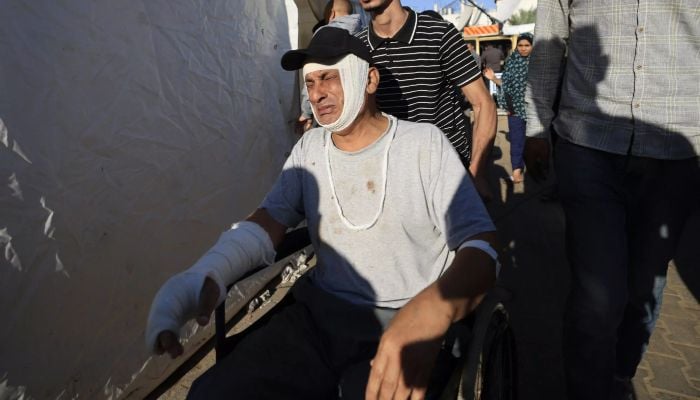
A wounded Palestinian man is wheeled outside Al-Aqsa hospital at Deir al-Balah, in central Gaza. AFP Photo
Hundreds of people fled on foot Saturday after the director
of Gaza's main hospital said Israel's army ordered evacuation of the facility
where more than 2,000 patients, medics and displaced people were trapped by the
war between Israel and Hamas.
Columns of sick and injured – some of them amputees –
displaced people, doctors and nurses, were seen making their way out of
Al-Shifa hospital towards the seafront without ambulances as loud explosions
were heard around the facility.
On the way, an AFP journalist saw at least 15 bodies, some
in advanced stages of decomposition, along a road lined by badly damaged shops
and overturned vehicles as Israeli drones buzzed overhead.
The Hamas-run health ministry said 120 wounded, along with
an unspecified number of premature babies, were still at Shifa hospital that
has become the focus of the seven-week war sparked by Hamas's unprecedented
October 7 attacks on Israel.
Israel has been pressing military operations inside the
hospital, searching for the Hamas operations centre it says lies under the
sprawling complex -- a charge Hamas denies.
Israel has vowed to destroy Hamas in response to the October
7 attacks which Israeli officials say killed about 1,200 people, most of them
civilians in southern Israel, and saw about 240 people taken hostage.
The army's relentless air and ground campaign has since
killed 12,000 people, including 5,000 children, according to the Hamas
government which has ruled Gaza since 2007.
In Gaza City on Saturday morning, Israeli troops had ordered
over loudspeakers the evacuation of Al-Shifa hospital "in the next
hour", an AFP journalist at the scene reported.
They called the hospital's director, Mohammed Abu Salmiya,
telling him to ensure "the evacuation of patients, wounded, the displaced
and medical staff, and that they should move on foot towards the
seafront", he said.
Israel's army denied ordering the evacuation, saying it had
"acceded to the request of the director of the Shifa Hospital to enable
additional Gazans who were in the hospital, and would like to evacuate, to do
so".
The United Nations estimated 2,300 patients, staff and
displaced Palestinians were sheltering at Al-Shifa before Israeli troops
entered the facility on Wednesday.
'They are all dead'
Israel has told Palestinians to move from the north of Gaza
for their safety, but deadly air strikes continue to hit central and southern
areas of the narrow coastal territory.
"They said the south was safer, so we moved,"
Azhar al-Rifi told AFP.
Her family was caught in a strike at the Nuseirat refugee
camp on Friday, killing seven of her relatives including her five-year-old
nephew. The same blast caught up Nada Abu Hiya, aged eight -- her third bombing
of the war.
"There are bombings everywhere," she said.
"My grandmother is dead, my mother is dead, my grandfather is dead, my
uncle is dead, they destroyed our house. Our neighbours' house is also
destroyed and they are all dead."
Israel has imposed a siege on Gaza, allowing just a trickle of aid in from Egypt but barring most shipments of fuel over concerns Hamas could divert supplies for military purposes.
 A picture taken from the border between Israel and Gaza shows leaflets dropped by the Israeli army over Gaza City, telling people to move to the south of the Palestinian territory. AFP Photo
A first consignment of fuel entered Gaza after Israel's war
cabinet bowed to pressure from its ally the United States and agreed to allow
two diesel tankers a day into the Palestinian territory.
"We took that decision to prevent the spread of
epidemics," Israel's national security adviser Tzachi Hanegbi said.
Raw sewage
A two-day blackout caused by fuel shortages ended after a
first delivery arrived from Egypt late Friday, but UN officials continued to
plead for a ceasefire, warning no part of Gaza is safe.
The UN agency for Palestinian refugees (UNRWA) said 70
percent of residents have no access to clean water in south Gaza, where raw
sewage has begun to flow on the streets.
UNRWA said Israel has agreed to allow in 60,000 litres
(16,000 gallons) of fuel daily from Egypt starting Saturday, but warned it was
little more than a third of what is needed to keep hospitals, water and
sanitation facilities running.
Humanitarian chief Martin Griffiths told the UN General
Assembly that fuel supplies to the agency so far were "a fraction of what
is needed to meet the minimum of our humanitarian responsibilities", which
the UN says have been hampered by a communications blackout.
The Hamas health ministry said 24 patients had died in 48
hours due to the lack of fuel for generators.
In Gaza, more than 1.6 million people have been internally
displaced, and Israel's blockade has left civilians facing the "immediate
possibility of starvation", according to World Food Programme head Cindy
McCain.
More than half of Gaza's hospitals are no longer functional
due to combat, damage or shortages, and people are waiting four to six hours
for half the normal portion of bread.
In the latest bloodshed, a strike on a residential building
in the southern city of Hamad killed 26 people, the director of the Nasser
hospital in Khan Yunis said.
"I was asleep and we were surprised by the strike. At
least 20 bombs were dropped," Imed al-Mubasher, 45, told AFP.
His wife Sabrin Mussa said: "All of a sudden, the house
caught fire. I found myself with gravel in my mouth and I immediately looked
for my husband and daughters.
"I saw human remains everywhere," and screamed for
help, she said.
The Israeli military has yet to respond to a request for
comment.
Starvation risk
Israel has come under scrutiny for targeting hospitals in
northern Gaza, but says the facilities are being used by Hamas – a claim
rejected by the group and medical staff.
The military says it has found rifles, ammunition,
explosives and the entrance to a tunnel shaft at the hospital complex, claims
that cannot be independently verified.
Israel has not recovered hostages at the hospital but said
it found the bodies of two kidnapped women including a woman soldier not far
away.
Those held hostage range from infants to octogenarians, and
there has been little information on their fate despite ongoing negotiations
mediated by Qatar and Egypt to secure releases.
Waving Israeli flags and placards depicting the hostages,
thousands of people approached Jerusalem Saturday on the fifth and final day of
a march calling for their release.
/KN/

