N Korea says spy satellite launch successful
AFP
22 Nov 2023 09:50 AM
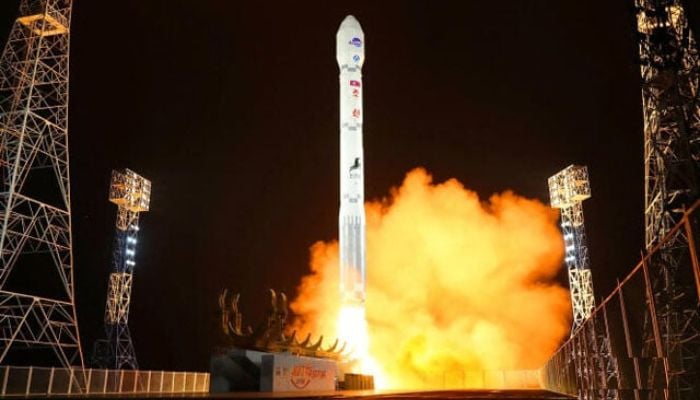
Collected Photo
North Korea said Wednesday it had succeeded in putting a
military spy satellite in orbit after two previous failures, as the US led its
allies in condemning the launch as a "brazen violation" of UN
sanctions.
A rocket carrying the satellite blasted off Tuesday night
from North Phyongan province, flew along its designated path and
"accurately put the reconnaissance satellite 'Malligyong-1' on its
orbit," state-run news agency KCNA reported.
North Korean leader Kim Jong Un was on hand to witness the
blast off, and congratulated the scientists and technicians behind the mission,
it added.
The United States quickly led condemnation of the launch as
a "brazen violation" of UN sanctions and said it could destabilize
the region.
South Korea reacted by saying it would resume surveillance
operations along the border with North Korea that had been suspended in 2018 as
part of a Seoul-Pyongyang agreement to reduce military tensions, the Yonhap
news agency reported.
North Korea's previous efforts to put a spy satellite into
orbit in May and August both failed. Seoul, Tokyo and Washington had repeatedly
warned Pyongyang not to proceed with another launch, which would violate
successive rounds of UN resolutions.
Space launch rockets and ballistic missiles have significant
technological overlap, experts say, but different payloads, and Pyongyang is
barred by UN resolutions from any tests involving ballistic technology.
Seoul's spy agency this month said Pyongyang appeared to
have received technical advice from Russia, in return for sending at least 10
shipments of weapons for Moscow's war in Ukraine.
KCNA said after this mission that "the launch of
reconnaissance satellite is a legitimate right of the DPRK for strengthening
its self-defensive capabilities" as the country confronts what it calls
threats from South Korea and the United States. DPRK (Democratic People's
Republic of Korea) is the official name for North Korea.
The North plans to launch more satellites "in a short
span of time" to step up its surveillance capability on South Korea, KCNA
said.
South Korea's Joint Chiefs of Staff said it was analyzing
the launch and did not confirm if the satellite had in fact been placed in
orbit.
"North Korea's military satellite launch constitutes a
provocative act that blatantly violates the UN Security Council resolutions
prohibiting its use of ballistic missile technology as well as scientific and
technological cooperation," the JCS said in a text message to reporters.
'Confidence in success'
Seoul has been saying for weeks that Pyongyang was in the
final stages of preparation to launch another spy satellite, warning it would
take "necessary measures" if it went ahead.
The North's May attempt failed due to the
"abnormal" startup of its second-stage engine, and the August bid due
to an error in the "emergency blasting system" during the third-stage
flight, according to Pyongyang state media at the time.
Tuesday's "launch that came hours before its time
window notification seems to underscore two things: Pyongyang's confidence in
success and intention to maximise surprise factor to the outside world,"
Choi Gi-il, professor of military studies at Sangji University, told AFP.
Russian President Vladimir Putin suggested in September
after meeting with North Korean leader Kim Jong Un that his nation could help
Pyongyang build satellites.
Seoul and Washington have both subsequently claimed
Pyongyang has been shipping weapons to Russia, with US Secretary of State
Antony Blinken warning this month that military ties between North Korea and
Russia were "growing and dangerous".
Successfully putting a spy satellite into orbit would
improve North Korea's intelligence-gathering capabilities, particularly over
South Korea, and provide crucial data in any military conflict, experts say.
North Korea has conducted a record number of weapons tests
this year.
Seoul, Washington and Tokyo have ramped up their defence
cooperation in response, and on Tuesday a US nuclear-powered aircraft carrier,
the USS Carl Vinson, arrived at South Korea's Busan Naval Base.
/KN/

