In Gaza, dozens of unidentified bodies buried in 'mass grave'
AFP
23 Nov 2023 13:42 PM
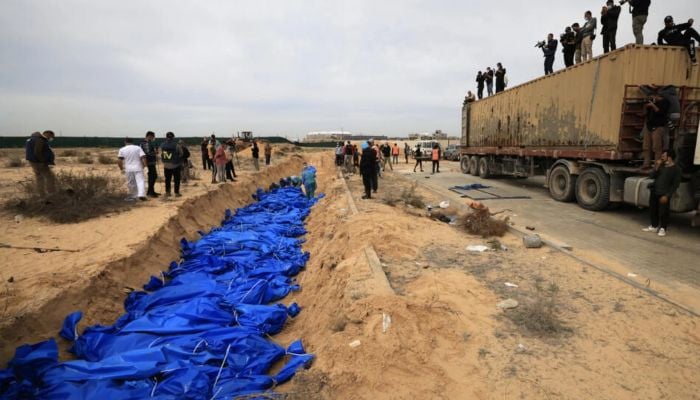
Dozens of blue-wrapped bodies are placed in a mass grave. AFP Photo
The bodies of dozens of unidentified people were buried on
Wednesday in a mass grave at a cemetery in Khan Yunis, in the southern Gaza
Strip.
Wrapped in blue tarpaulin, the bodies were lowered on
stretchers, some of them stained with blood, into a sandy pit that was
gradually enlarged by a digger. Some were the size of children.
"As these martyrs had no one to say goodbye to, we dug
a mass grave to bury them. They are unknown martyrs," Bassem Dababesh of
the emergency committee at the religious affairs ministry told AFP.
The remains, which bore only numbers, had come from the
Indonesian and Al-Shifa hospitals in the northern Gaza Strip, according to
members of the committee at the burial site.
The Indonesian hospital on the edge of the Jabalia refugee
camp, which had been hit by Israeli air strikes, was partly evacuated on
Monday, said Ashraf al-Qudra, spokesman for the Hamas-controlled health
ministry.
Bodies everywhere
"There were bodies everywhere. If I hadn't seen it with
my own eyes I wouldn't have believed it," said Umm Mohammed al-Ran, a
woman evacuated from the Indonesian hospital towards Rafah in the south.
"Wounded people died in front of us as they bled
out," she told AFP.
"The stench of death was everywhere in the hospital.
The wounded were crying out for painkillers, but the doctors didn't have any to
give them."
She held up her phone to show a video she had taken. It
showed worms crawling from the infected wound on a patient's leg.
It's a similar situation at the Al-Shifa hospital in Gaza
City, the territory's largest.
On November 14, that hospital's director Mohammad Abu
Salmiya said 179 bodies had been buried in a mass grave inside the complex.
Among them were seven premature babies who died because
there was no electricity to power their incubators.
The bodies that arrived at Khan Yunis on Wednesday would
have been "detained" by Israel before being released after
representations from "third countries and the United Nations",
according to the emergency committee at the religious affairs ministry.
Khalil Siam, director of a transport company, told AFP that
the bodies had arrived the night before, and it was not known "if they're
decomposing or not".
AFP contacted the Israeli military and several UN agencies
operating in Gaza, but no reply had been received late Wednesday.
'Despair and loss'
There are thousands of dead in the Gaza Strip, and the
question of burials has shocked many Gazans.
Since the war began, war dead have been buried hastily in
private plots of land and even a football field, when cemeteries are full or
inaccessible because of the fighting.
A week after the war began, Philippe Lazzarini, the head of
the UN agency for Palestinian refugees (UNRWA), said there was a shortage of
body bags.
"Every story coming out of Gaza is about survival,
despair and loss," he said.
The war began on October 7 after Hamas launched the worst
attack in Israel's history that left around 1,200 people dead, most of them
civilians, according to the Israeli government.
Hamas also seized 240 hostages.
Israel launched a major bombing campaign and then a ground
offensive in Gaza which, according to the Hamas government, has killed 14,100
people, thousands of them children.
Thousands of dead are also believed to be buried under the
rubble.
/KN/

