Anti-Islam populist leader wins Dutch election
Online Desk
23 Nov 2023 15:33 PM
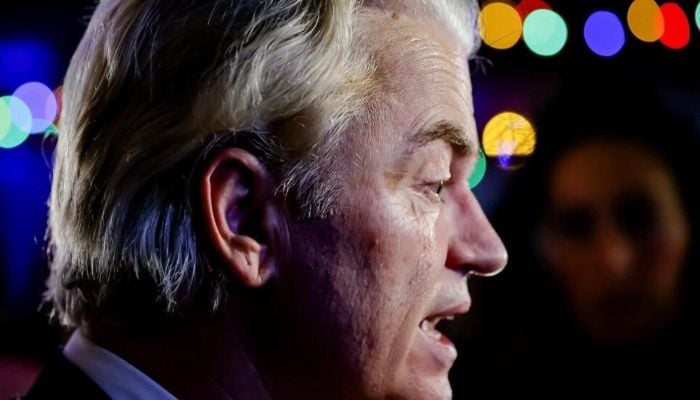
AFP Photo
Veteran anti-Islam populist leader Geert Wilders has won a
dramatic victory in the Dutch general election, according to the latest results
with almost all votes counted. BBC reports.
After 25 years in parliament, his Freedom party (PVV) is set
to win 37 seats, well ahead of his nearest rival, a left-wing alliance.
"The PVV can no longer be ignored," he said.
"We will govern."
His win has shaken Dutch politics and it will send a shock
across Europe too.
But to fulfil his pledge to be "prime minister for
everyone", he will have to persuade other parties to join him in a
coalition. His target is 76 seats in the 150-seat parliament.
Wilders, 60, harnessed widespread frustration about
migration promising "borders closed", and he put on hold his promise
to ban the Koran.
He was in combative mood in his victory speech: "We
want to govern and... we will govern. [The seat numbers are] an enormous
compliment but an enormous responsibility too."
Before the vote, the three other big parties ruled out
taking part in a Wilders-led government because of his far-right policies. But
that might change because of the scale of his victory.
The left-wing alliance under ex-EU commissioner Frans
Timmermans is set to come second with 25 seats. He made clear he would have
nothing to do with a Wilders-led government.
It was time to defend Dutch democracy and rule of law,
Timmermans told supporters: "We won't let anyone in the Netherlands go. In
the Netherlands everyone is equal."
That leaves third-placed centre-right liberal VVD under new
leader Dilan Yesilgöz, and a brand new party formed by whistleblower MP Pieter
Omtzigt in fourth.
Freedom party leader Wilders made a direct appeal to his
political rivals to work together, and both Yesilgöz and Omtzigt congratulated
him on his success.
Although Yesilgöz doubts Wilders will be able to find the
numbers he needs, she says it is up to her party colleagues to decide how to
respond. Before the election she insisted she would not serve in a Wilders-led
cabinet, but did not rule out working with him if she won.
Omtzigt said initially his New Social Contract party would
not work with Wilders, but now says they are "available to turn this trust
[of voters] into action".
A Wilders victory will send shockwaves around Europe, as the
Netherlands is one of the founding members of what became the European Union.
Nationalist and far-right leaders around Europe praised his
achievement. French National Rally leader Marine Le Pen said it "confirms
the growing attachment to the defence of national identities".
Wilders wants to hold a referendum to leave the EU, dubbed a
"Nexit", although he recognises there is no national mood to do so.
He tempered his anti-Islam rhetoric in the run-up to the
vote, saying there were more pressing issues at the moment and he was prepared
to "put in the fridge" his policies on banning mosques and Islamic
schools.
The strategy was a success, more than doubling his PVV
party's numbers in parliament.
During the campaign Wilders took advantage of widespread
dissatisfaction with the previous government, which collapsed in a disagreement
over asylum rules.
For political scientist Martin Rosema from the University of
Twente, it was one of several gifts that had been handed to Wilders on a plate
in a matter of months. Another was that the centre-right liberal leader had
opened the door to working with him in coalition.
"We know, also from international precedent, that
radical right-wing parties fare worse when they're excluded," he said.
Migration became one of the main themes, and Wilders made
clear on Wednesday he intended to tackle a "tsunami of asylum and
immigration".
Last year net migration into the Netherlands more than
doubled beyond 220,000, partly because of refugees fleeing Russia's invasion of
Ukraine. But the issue has been aggravated by a shortage of some 390,000 homes.
At the Hague headquarters of Yesilgöz's VVD, supporters had
been preparing to raise their glasses at the prospect of the Netherlands' first
female prime minister.
But there was a collective gasp of disbelief when the exit
polls flashed up on the screens and they huddled over their phones trying to
understand what went wrong.
Yesilgöz's took over as centre-right leader when the
country's longest-serving prime minister, Mark Rutte, bowed out of politics in
July. She came to the Netherlands as a seven-year-old refugee from Turkey but
has adopted a hard line on immigration.
Some politicians and Muslim figures have accused her of
opening the door to the far right by refusing to rule out working with Geert
Wilders.
Yesilgöz, 46, had tried to distance herself from the Rutte
government in which she was justice minister, but ultimately she was unable to
live up to the opinion polls.
Right up to the eve of the election, almost half of the
electorate were being described as floating voters. Many of those may well have
decided not to back her.
A measure of Wilders' success in winning over voters came
from one Muslim voter in The Hague who said: "If he wasn't so opposed to
Muslims, I'd be interested in him."
Hours before the vote, Wilders was buoyant about his
chances, telling the BBC. "I think it's the first time ever in Holland
that in one week we gained 10 seats in the polls."
He was realistic about the uphill task he faced in forming a
government led by him, but he said he was a positive person and victory would
make it "difficult for the other parties to ignore us".
/KN/

