Young Rohingya leave Bangladesh camps for university dream
AFP
29 Nov 2023 11:54 AM
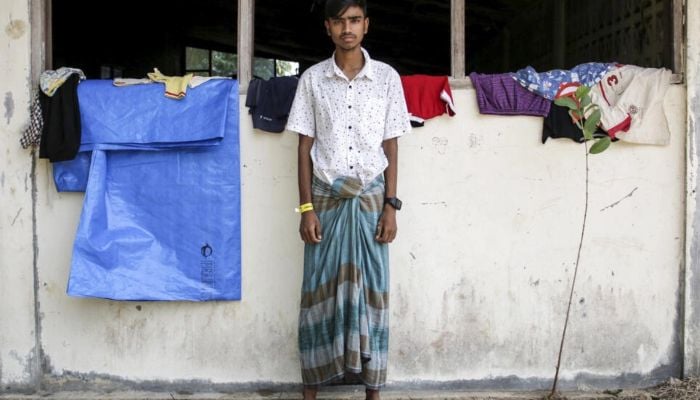
Rohingya refugee Abdur Rahaman poses for a photo at a temporary Indonesian immigration shelter in Aceh province's Lhokseumawe. AFP Photo
Muhammed Hasson said a painful goodbye to his parents in a
refugee camp in Bangladesh before embarking on a dangerous sea journey,
refusing to let Myanmar's crackdown six years ago on Rohingyas like him crush
his dream of attending university.
The 18-year-old spent weeks at sea with only the clothes on
his back, a few supplies and his hopes of becoming a coder.
Then, last week, he landed on a beach in Indonesia's
westernmost province of Aceh, part of a wave of more than 1,000 Rohingyas who
have arrived since November 14 amid improved sailing conditions.
"I came here to get an opportunity to go to
university," Hasson told AFP in a temporary shelter in Indonesia's
Lhokseumawe city, eight hours by bus and ferry from where he initially
disembarked.
The Myanmar military's 2017 campaign drove more than 740,000
Rohingyas into neighbouring Bangladesh, bringing reports of murder, arson and
rape in a crackdown that has prompted a United Nations genocide investigation.
Dhaka bars formal education inside more than two dozen
refugee camps where residents say criminal gangs target the educated, leaving
an entire generation at risk of losing years of study vital to their future.
To escape this grim outlook, Hasson borrowed money from his
family to pay a middleman for the 1,800-kilometre (1,120 miles) journey to
Indonesia, which has more Muslims than any other nation.
"I like physics and mathematics. I want to study
computer science engineering. That is my ambition," he said.
'Be killed'
AFP reporters who visited camps in Cox's Bazar last week
said Rohingya refugees reported a dire lack of education facilities and were
fearful of criminal gangs that abduct people for ransom.
"Our children are not able to study here, our suffering
has no end here – we feel suffocated, we can't even sleep due to grief,"
refugee Nur Jahan told AFP, speaking after being detained by Bangladeshi police
and prevented from boarding a boat bound for Indonesia.
The UN says only a few temporary learning centres – teaching
English, maths, the Burmese language and life skills – have been set up across
the sprawling camps that have grown to host more than one million in
Bangladesh.
Other problems highlighted by the UN included a shortage of
qualified teachers for hundreds of thousands of Rohingya children and the lack
of an official curriculum.
Mohammed Ayas, a friend of Hasson's who also made the
perilous sea crossing, said he could not stay in Bangladesh because of the
restrictions and threats he faced there.
"Anyone good in education will be killed. Many people
who pursued education have been killed by the criminal groups," he said.
Phil Robertson, deputy Asia director of Human Rights Watch,
said that lack of access to education, along with movement restrictions and
insufficient health services, was contributing to mass Rohingya desperation.
"The result is such high levels of fear and desperation
that it seems sensical to risk a dangerous sea journey on a rickety boat to
seek a new life," he said.
Ayas said that, like Hasson, he borrowed money from his
relatives to pay 70,000 Bangladeshi taka ($637) for the trip to Indonesia.
The second of 10 siblings said he and his parents cried when
he departed for his new life.
"They were worried and sad, but they agreed. Every
parent tries to save their children," he said.
'Not be denied'
But refugees still face challenges in obtaining an education
in Indonesia.
The archipelago nation is not a signatory to the UN Refugee
Convention and says it is not compelled to take in refugees from Myanmar.
Before the latest wave of arrivals, Indonesia hosted only
around 1,000 Rohingyas, according to the UN refugee agency.
Some Indonesian universities have accepted refugees in
special cases, but opportunities remain limited without Indonesian residency,
an official sponsor or significant funds, experts say.
Fifteen-year-old Abdur Rahman was undeterred, though.
He sought asylum in Indonesia with his mother and two
younger brothers after being limited to home study in Bangladesh.
The English-language enthusiast said he hoped leaving the
camps would boost his chances of getting an education.
Eventually, he wants to become a journalist, able to write
and spread awareness about the plight of his people.
"Rohingya people currently have no country and no
shelter," he said.
"I want to help them."
/KN/

