Indian SC backs scrapping Jammu and Kashmir autonomy
Online Desk
11 Dec 2023 14:01 PM
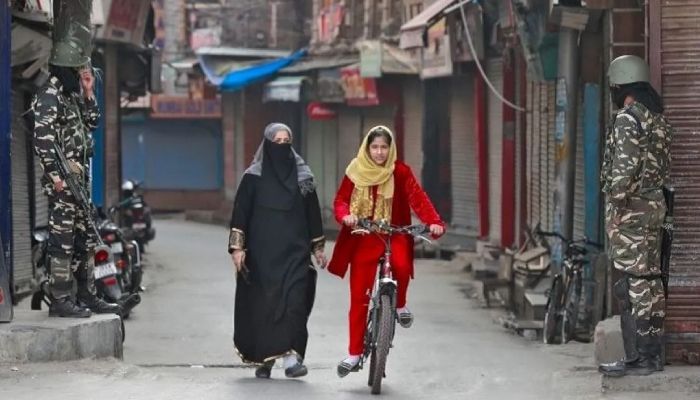
A Kashmiri girl pedals her bicycle past Indian security officers standing guard in front of a closed shop on a street in Srinagar. Reuters Photo
India's Supreme Court on Monday backed the Centre's move to
scrap special status to Jammu and Kashmir under Article 370 of the Constitution
and ordered elections next year, NDTV reports.
Article 370 was a temporary provision to ease Jammu and
Kashmir's merger with India, said Chief Justice of India DY Chandrachud,
reading out a majority Supreme Court judgment.
The court said Jammu and Kashmir should be put on par with
other states "at the earliest and as soon as possible", and called
for state elections by September 30, 2024.
Jammu and Kashmir did not retain sovereignty when it joined
India and its constituent assembly ceased to exist the moment it merged with
India, the Supreme Court said, explaining the decision.
"The J&K constituent assembly was not intended to
be a permanent body. It was formed only to frame the Constitution. The
recommendation of the Constituent Assembly was not binding on the
President," said Chief Justice Chandrachud.
The Supreme Court, however, explained why the state
continued to enjoy special status even after its merger with India, despite the
state not having "internal sovereignty".
"When the constituent assembly ceased to exist, the
special condition for which Article 370 was introduced also ceased to exist.
But the situation in the state remained, and thus the Article continued,"
the Supreme Court said.
"All states in the country have legislative and
executive power, albeit to differing degrees. Articles 371A to 371J are
examples of special arrangements for different states. This is an example of
asymmetric federalism... Jammu and Kashmir does not have internal sovereignty
different from other states," the Supreme Court said.
The bench gave three separate judgments - one authored by
Chief Justice Chandrachud on behalf of himself, Justice BR Gavai and Justice
Surya Kant; another concurring judgment by Justice Sanjay Kishan Kaul, and a
third judgment concurring with the other two by Justice Sanjiv Khanna.
Article 370 gave Jammu and Kashmir its own Constitution and
decision-making rights for all matters barring defence, communications and
foreign affairs. Its removal ended the special status of the state.
Contained within Article 370 was Article 35A, which allowed
the erstwhile state to define who it acknowledged as permanent residents and
gave special rights, such as government jobs and owning property.
The Supreme Court said it did not find it necessary to see whether the reorganisation of Jammu and Kashmir into a Union Territory was valid since it was a temporary arrangement until the election and restoration of statehood.

