N Korea's Kim warns of nuclear attack
AFP
21 Dec 2023 13:58 PM
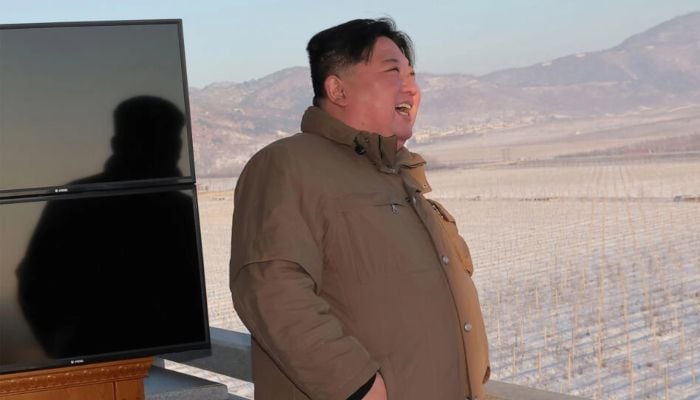
North Korean leader Kim Jong Un earlier this week oversaw another test launch of his country's largest ICBM. AFP Photo
North Korean leader Kim Jong Un warned Pyongyang will not
hesitate to launch a nuclear attack if "provoked with nukes", state
media said Thursday, while Seoul and its allies called for "dialogue
without preconditions".
Kim's warning follows a meeting between South Korea and the
United States last week in Washington, where they discussed nuclear deterrence
in the event of conflict with the North.
The meeting's agenda included "nuclear and strategic
planning", and the allies reiterated that any nuclear attack by Pyongyang
on the United States or South Korea would result in the end of the North Korean
regime.
But Kim told his military's missile bureau "not to
hesitate (launching) even a nuclear attack when the enemy provokes it with
nukes," Pyongyang's official Korean Central News Agency said Thursday.
Washington, Seoul and Tokyo released a statement shortly
afterwards, urging the nuclear-armed country to "stop conducting further
provocations and accept our call for engaging in substantive dialogue without
preconditions".
The three countries have ramped up defence cooperation in
the face of a record-breaking series of weapons tests by Pyongyang this year,
and on Tuesday activated a system to share real-time data on North Korean
missile launches.
On Monday, the North launched its most powerful
intercontinental ballistic missile, the Hwasong-18, later describing it as
"a warning counter-measure" against what it described as persistent
acts of "military threat" by Washington and its allies.
Last week, a US nuclear-powered submarine arrived in the
South Korean port city of Busan, and on Wednesday, Washington flew its
long-range bombers in drills with Seoul and Tokyo.
The North has recently stressed that the "Korean
peninsula is in a state of war by law" and that "strategic
assets" deployed by Washington in the South will be "the first
targets of destruction".
In October, when a US B-52 bomber capable of carrying
nuclear weapons took part in the first joint aerial drills conducted by Seoul,
Tokyo and Washington, Pyongyang described the exercise as "the intentional
nuclear war provocative moves of the US".
Pyongyang sees drills by the United States and its allies as
rehearsals for invasion and has long justified its blitz of missile launches as
necessary "countermeasures".
Seoul's defence minister has been making unusually fiery
remarks of late and last week warned that Pyongyang would face a "hell of
destruction" if it engaged in any "reckless" action that
"destroys peace".
The two Koreas are at a "peak of escalating rhetoric
and pre-emptive strike threats," Yang Moo-jin, president of the University
of North Korean Studies in Seoul, told AFP.
The latest developments "clearly reflect the
seriousness of the situation and the current (turbulent) state of affairs on
the Korean Peninsula", he added.
'Preparations for invasion'
Pyongyang last year declared itself an
"irreversible" nuclear power and has repeatedly said it will never
give up its nukes programme, which the regime views as essential for its
survival.
In a separate statement Thursday, Kim's powerful sister, Kim
Yo Jong, slammed the United Nations Security Council for convening a session to
discuss the North's latest ICBM launch, arguing it was a demonstration of
Pyongyang's inherent right to self-defence.
"The ceaseless military drills of the US and its vassal
forces (remind) one of the overall preparations for invasion under the pretext
of deterring threats from someone," she said, according to KCNA.
"And the frequent appearance of the US nuclear weapons
clearly (aimed) at the DPRK ... is the root cause of escalating the regional
situation," she added, using the acronym for the North's official name.
Pyongyang's launch of a military spy satellite last month,
which it claimed quickly began providing images of US and South Korean military
sites, further damaged inter-Korean ties.
The launch fractured a military agreement between the Koreas
established to de-escalate tensions on the peninsula, with both sides then
ramping up security along the Demilitarized Zone (DMZ) that separates them.
/KN/

