North Korea abandons unification goal with South
Online Desk
17 Jan 2024 10:15 AM
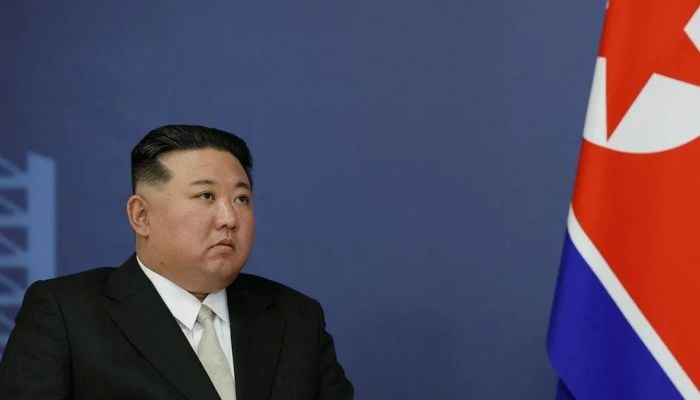
Kim's comments came as relations significantly weakened on the Korean Peninsula in recent months. Reuters Photo
North Korean leader Kim Jong Un has said unification with
the South is no longer possible, and that the constitution should be changed to
designate it the "principal enemy".
Kim also said three organisations dealing with reunification
would shut down, BBC reports citing state media KCNA.
South Korea's president said it would respond "multiple
times stronger" to any provocation from the North.
The two Koreas have been divided since the Korean War ended
in 1953.
They did not sign a peace treaty and therefore have remained
technically still at war ever since.
In a speech delivered at the Supreme People's Assembly -
North Korea's rubber-stamp parliament - Kim said that the constitution should
be amended to educate North Koreans that South Korea is a "primary foe and
invariable principal enemy".
He also said that if a war breaks out on the Korean
peninsula, the country's constitution should reflect the issue of
"occupying", "recapturing" and "incorporating"
the South into its territory.
Kim - who replaced his father, Kim Jong-il, as North Korean
leader in 2011 - said the North "did not want war, but we also have no
intention of avoiding it", according to KCNA.
He said he was taking a "new stand" on north-south
relations, which included dismantling all organisations tasked with
reunification.
Speaking to his cabinet on Tuesday, South Korean President
Yoon Suk Yeol said that if the North carried out a provocation, the South
"will retaliate multiple times stronger", pointing to the South
Korean military's "overwhelming response capabilities".
Dr John Nilsson-Wright, who heads the Japan and Koreas
Programme at Cambridge University's Centre for Geopolitics, described Kim's
remarks as "unprecedented", and said it was "highly
unusual" for a North Korean leader to depart from the policy of
unification.
"It's not unusual for relations between the North and
South to cool, but this has taken the relationship in a different
direction," he told the BBC.
He added that Kim's anti-Western stance can be traced back
to the 2019 summit with then-US President Donald Trump in Vietnam, which ended
without an agreement.
"This has been an acute disappointment and loss of face
for Kim," Dr Nilsson-Wright said.
Heightened tensions
Kim's comments came as relations significantly weakened on
the Korean Peninsula in recent months.
In November, North Korea fully suspended a five-year
military deal with the South aimed at lowering military tensions. It promised
to withdraw all measures "taken to prevent military conflict in all
spheres including ground, sea and air", and said it would deploy more
forces to the border region.
The South had partly suspended the agreement days earlier
after Kim claimed to have successfully launched a spy satellite into space.
The rhetoric - and provocative actions - from the North have
only escalated since then.
At year-end policy meetings, Kim said he needed to
"newly formulate" the North's stance towards inter-Korean relations
and reunification policy, adding that the stated goal was to "make a
decisive policy change" related to "the enemy".
He also threatened a nuclear attack on the South, and called
for a build-up of his country's military arsenal.
The North has also launched missiles in recent weeks, as
well as live-fire exercises close to South Korean territory.
In a report published last week for 38 North, a US-based
organisation with a focus on North Korea, former State Department official
Robert Carlin and nuclear scientist Siegfried S Hecker said they saw the
situation on the Korean Peninsula as "more dangerous than it has ever
been" since the start of the Korean War in 1950.
"That may sound overly dramatic, but we believe that,
like his grandfather in 1950, Kim Jong Un has made a strategic decision to go
to war," it said.
"We do not know when or how Kim plans to pull the
trigger, but the danger is already far beyond the routine warnings in
Washington, Seoul and Tokyo about Pyongyang's 'provocations'."
It added that it did not see the "war preparation
themes" in North Korean media as "typical bluster".
Dr Nilsson-Wright agreed and said the "risk of
escalation should be taken seriously".
Meanwhile North Korea's Foreign Minister Choe Son Hui is in
Russia where she is expected to meet President Vladimir Putin.
The two countries have boosted ties recently, with both
isolated by Western powers, and last September Kim visited Russia where he met Putin.
/KN/

