India PM inaugurates temple on razed mosque site
Online Desk
22 Jan 2024 15:37 PM
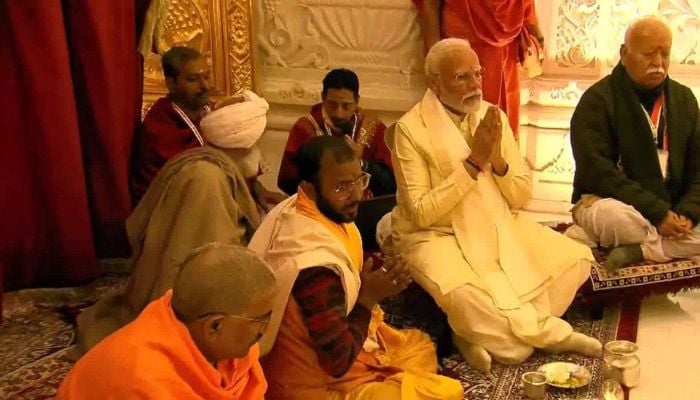
India's PM Narendra Modi has inaugurated a grand temple to
Hindu god Ram in the flashpoint city of Ayodhya, BBC reports.
The temple replaces a 16th-Century mosque razed by Hindu
mobs in 1992. The demolition had sparked nationwide riots in which nearly 2,000
people died.
Thousands of invited guests, including top film stars and
cricketers, attended the event in Ayodhya.
But some Hindu seers and most of the opposition boycotted
it, saying Modi was using it for political gains.
General elections are due in India in the next few months
and Modi's political rivals say the governing Bharatiya Janata Party (BJP) will
be seeking votes in the temple's name in a country where 80 per cent of the
population is Hindu.
Critics have also accused the government of going overboard
with what is essentially a religious celebration in a country which - according
to its constitution - is secular.
The temple has been constructed at a cost of $217m (£170m) -
the temple trust says it's been funded from private donations.
The ceremony, which was televised live, showed Modi
performing religious rituals inside the temple's sanctum along with priests and
Mohan Bhagwat, head of Rashtriya Swayamsevak Sangh (RSS) - the ideological
fountainhead of Hindu nationalist parties. Only the ground floor of the temple
was opened - the rest of the structure is expected to be completed only by the
end of the year.
The ceremony, called Pran Pratishtha, which loosely
translates from Sanskrit into "establishment of life force", lasted
about an hour. Hindus believe that chanting of mantras and a set of rituals
performed around a fire will infuse sacred life in an idol or a photograph of a
deity.
The temple fulfils a decades-long Hindu nationalist pledge
to build a shrine to Lord Ram in Ayodhya - the flashpoint city is getting a
major makeover to transform it into a destination for pilgrims and tourists
from across the world.
Many Hindus believe that Ayodhya is the birthplace of Ram
and the Babri mosque was built by Muslim invaders on the ruins of a Ram temple
at the exact spot where the Hindu god was born. The movement to build a temple
at the same site was a major factor that propelled the BJP into political
prominence in the 1990s.
A protracted legal battle about the ownership of the land
followed the mosque's demolition. It was resolved in 2019 when the Supreme
Court gave the disputed land to the Hindus. Muslims were given a plot outside
the city to build a mosque.
In Ayodhya, some Muslims told the BBC before the event that
the day evoked fear and painful memories for them. Some said they would send
their children out of the city, fearing tensions might be stoked when the
streets filled with Hindu devotees from around the country.
The new three-storey temple - made with pink sandstone and
anchored by black granite - stretches across 7.2 acres in a 70-acre complex. A
51-inch (4.25-ft) statue of the deity, specially commissioned for the temple,
was unveiled last week. The idol has been placed on a marble pedestal in the
sanctum sanctorum.
Since Monday morning in Ayodhya, all roads have led to the
new temple. Thousands of policemen have been deployed to ensure security and
manage traffic. Saffron-coloured flags of the BJP and those with images of
Hindu gods dot major roads, many of which have been decorated with bright
yellow and orange marigold flowers.
Some of India's biggest celebrities, including Bollywood
star Amitabh Bachchan and cricketer Sachin Tendulkar, were among those who
attended the event.
To avoid crowding in the small city, Modi had appealed to
pilgrims to not turn up in Ayodhya in large numbers but to watch the ceremony
live on television. To facilitate that, all the BJP-ruled states have shut
schools and colleges and declared a full or a half-day government holiday and
stock markets are shut to encourage people to watch the ceremony.
The atmosphere is celebratory among Hindus in many northern
Indian cities. Modi has asked people to light up lamps and party supporters
have put up saffron flags with images of Ram on their rooftops, including in
several Delhi neighbourhoods. Film theatres are screening the event, and big
television screens have been set up at town squares and in residential
colonies.
Modi had called the temple a major achievement and said that
the country was "eagerly waiting" for its opening.
"Many generations had looked forward to this
moment," he said in a message earlier this month, adding that he would be
"representing all of India's 1.4 billion people" at the consecration
ceremony.
But a sour note was struck with some top religious seers
saying that as the temple was not yet complete, it was against Hinduism to
perform these rituals there, and many opposition leaders deciding to stay away.
Some of the opposition-ruled states have also announced
their own plans for the day - West Bengal Chief Minister Mamata Banerjee said
she would pray at the iconic temple to goddess Kali in Kolkata and then lead an
all-faith rally. The eastern state of Odisha (Orissa) unveiled huge plans to
bring pilgrims to the Jagannath temple in Puri, one of the holiest sites for
Hindus.
Authorities say they expect more than 150,000 visitors per
day once the temple in Ayodhya is fully ready.
To accommodate this expected rush, the city has been the
site of frenzied construction work for months. In recent weeks, a brand new
airport and a railway station have been opened, several new hotels have been
built and the existing ones have been spruced up.
The government has allotted $3.85bn (£3.01bn) for the
transformation of Ayodhya, the tranquil pilgrim town on the banks of Saryu
river, a tributary of the Ganges.
Officials say they are building a "world-class city
where people come as pilgrims and tourists", but many local people have
told the BBC that their homes, shops and "structures of religious
nature" have been either completely or partially demolished to expand
roads and set up other facilities.
/KN/

