Netanyahu under pressure over Israel troop losses, hostages
AFP
24 Jan 2024 10:05 AM
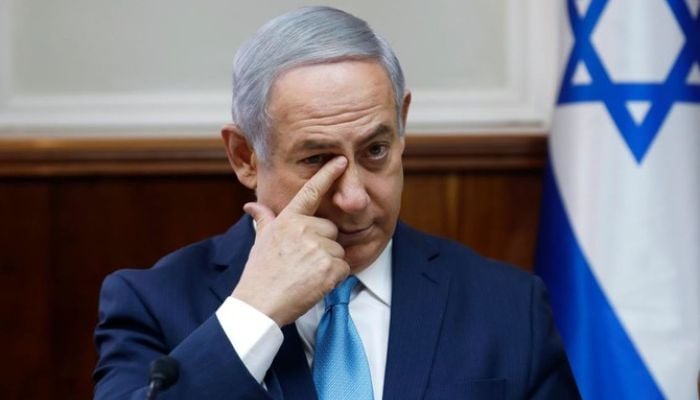
Questions are being asked about Israel's military strategy in Gaza after troop losses
Prime Minister Benjamin Netanyahu faces a mounting crisis
after Israel's worst day of troop losses in the Gaza war as well as growing
protests over his failure to bring hostages back.
The military's strategy in the Palestinian territory is
under intense scrutiny following the death of 24 troops on Monday, Israel's
biggest one-day loss since its ground offensive in Gaza started in late
October.
Among those killed were 21 reservists, who died in a single
incident.
The incident, which saw rocket-propelled grenade fire hit a
tank and two buildings the soldiers were trying to blow up, was deemed a
"disaster" by Netanyahu.
Emmanuel Navon, a lecturer at Tel Aviv University, told AFP
the troop losses "affect everybody, because almost everybody in the
country has a son or brother or a relative (fighting in Gaza)".
Israelis would now be increasingly asking "what is the
strategy... Do we really keep going until we finish Hamas?", he added.
At the same time, splits have emerged in Netanyahu's war
cabinet following protests in Tel Aviv and outside his Jerusalem home, where
relatives of hostages staged a rally Monday chanting "everybody and
now" to urge the return of captives.
"The current mood in the war cabinet is very bad,"
said Julia Elad-Strenger, a lecturer at Bar-Ilan University near Tel Aviv.
Netanyahu's steadfast vow to eliminate the Palestinian
militant group Hamas in response to the October 7 attack is increasingly seen
within the cabinet as incompatible with returning hostages held in Gaza,
experts told AFP.
War cabinet divided
Two members of the five-person war cabinet, Benny Gantz and
Gadi Eisenkot, have rejected Netanyahu's stance that only military pressure on
Hamas will allow the return of hostages, the experts said.
"According to Netanyahu there can be no victory with
Hamas left standing, according to Gantz and Eisenkot there can be no victory
with hostages lost," said Reuven Hazan, a professor of political science
at the Hebrew University of Jerusalem.
Eisenkot, whose son died fighting in Gaza, gave an interview
last week in which he split from Netanyahu's long-held position.
"It is impossible to return the hostages alive in the
near future without an agreement (with Hamas)," he told Israeli
broadcaster Channel 12.
Netanyahu has vowed "total victory" over Hamas in
response to the unprecedented attack by its fighters on October 7 that resulted
in the deaths of about 1,140 people, mostly civilians, according to an AFP
tally based on official Israeli figures.
The militants seized about 250 hostages and Israel says
around 132 remain in besieged Gaza, including the bodies of at least 28 dead
hostages, according to an AFP tally based on Israeli data.
In response to the attack, Israel has launched a relentless
offensive in Gaza that has killed at least 25,490 people, around 70 percent of
them women, young children and adolescents, according to the latest toll issued
Tuesday by Gaza's health ministry.
'Worst point'
Netanyahu has rejected suggestions that his government
should hold another round of talks with Hamas to reach a similar deal to one
struck in November that led to the release of 80 Israeli hostages.
Under that deal, brokered by Qatar, the United States and
Egypt, a seven-day humanitarian pause was agreed that allowed aid deliveries
into Gaza, while hundreds of Palestinian prisoners were released in exchange
for hostages.
The Israeli premier doubled down on his refusal to enter
talks with Hamas on Sunday, saying: "The conditions demanded by Hamas
demonstrate a simple truth: there is no substitute for victory."
Netanyahu said Hamas had set conditions for the release of
more hostages that included an end to the war, withdrawal of Israeli forces
from Gaza and guarantees that the group will stay in power.
Experts said they expected the Israeli premier to continue
the war as a tactic to remain in power, even as pressure to change course
mounts.
"I think he has made a decision to keep this war going
and not just for his political interests, but endless war is his strategy in
general," said Mairav Zonszein, a senior analyst at the International
Crisis Group.
"As far as Netanyahu is concerned, if the war lasts
beyond 2024 that's better for him politically because it gets October 7 further
away from us and it gives him a chance to rebuild," said Hazan of Hebrew
University.
"Right now he is at the worst point in his entire
career," said Hazan.
/KN/

