Israel floods Hamas tunnels as UN pleads for aid funding
AFP
31 Jan 2024 12:45 PM
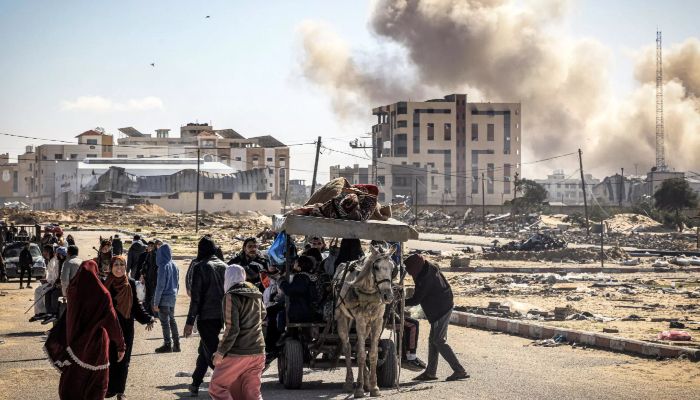
Smoke from bombardment billows in the background as displaced Palestinians flee Khan Yunis. AFP Photo
Israel's army has begun flooding Hamas's network of tunnels
as intense fighting rages in Gaza, with the UN warning of the potential
"collapse of the humanitarian system" in the territory after a
funding row hit its Palestinian aid agency.
The epicentre of the fighting in recent weeks has been Khan
Yunis, southern Gaza's main city, where vast areas have been reduced to a muddy
wasteland of bombed-out buildings, and where an AFP journalist witnessed people
leaving town on Tuesday as explosions sounded nearby.
"We left the Nasser hospital without any mattresses,
under tank and air strikes. We didn't know where to go," said one young
woman.
"We're out in the cold, left to fend for ourselves,
with no tents and nothing to survive on."
Elsewhere in the city, Israeli troops gave journalists a
tour of a tunnel they said had been used as a Hamas command centre.
"Every war has its own characteristics, and I think
that this war, its basic character is about that over- and underground
manoeuvre," Dan Goldfus, commander of the 98th Paratroopers Division, told
reporters outside of the shaft.
"I think the enemy is on the run and is trying to put
itself under the civilians as much as it can," he added.
The Israeli military, which has dubbed the vast network of
tunnels "the Gaza metro", said Tuesday that it had begun flooding the
underground complexes with water in a bid to "neutralise the threat of
Hamas' subterranean network".
UNRWA row
The war was touched off by Hamas's October 7 attacks on
Israel, which resulted in the deaths of around 1,140 people, mostly civilians,
according to an AFP tally based on official Israeli figures.
About 250 foreign and Israeli hostages were also dragged to
Gaza during the October 7 attack, of whom around 132 are still there. That
figure includes the bodies of at least 28 people believed to have been killed.
Following the Hamas attack, Israel launched a withering air,
land and sea offensive in Gaza that has killed at least 26,751 people, mostly
women and children, according to the health ministry in the Hamas-run
territory.
The war has displaced the vast majority of Gaza's
population, according to the UN, which warned the humanitarian crisis in the
besieged territory would only get worse if major donors didn't restore funding
to UNRWA, its main aid agency for Palestinians.
Israel has alleged that several agency staff members took
part in the October 7 attacks, leading key donor countries including the United
States and Germany to suspend funding.
The UN's coordinator for Gaza aid, Sigrid Kaag, said Tuesday
that no other agency could "replace or substitute" UNRWA, which has
thousands of employees.
The heads of several UN agencies, including the WHO, the UN
rights office, UNICEF and the World Food Programme, later issued a statement
warning that defunding UNRWA would "have catastrophic consequences for the
people of Gaza".
Withholding the funds, they said, was "perilous and
would result in the collapse of the humanitarian system in Gaza, with
far-reaching humanitarian and human rights consequences".
Washington, which said it had given $131 million to UNRWA
since October, said it "very much supported" the agency's work.
"We want to see that work continued, which is why it is
so important that the United Nations take this matter seriously, that they
investigate, that there is accountability for anyone who is found to have
engaged in wrongdoing," said State Department spokesman Matthew Miller.
Truce proposal
After a recent meeting in Paris between US, Israeli,
Egyptian and Qatari officials yielded a proposed framework for a truce, Hamas
confirmed on Tuesday it had received the proposal and was "in the process
of examining it and delivering its response".
Qatari Prime Minister Sheikh Mohammed bin Abdulrahman Al
Thani, whose government helped broker a previous truce in November, voiced hope
an initial deal might lead to a permanent ceasefire.
Sheikh Mohammed said the current plan included a phased
truce that would see women and children hostages released first, with more aid
also entering Gaza.
The United States also expressed hope for a deal, with
Secretary of State Antony Blinken saying that "very important, productive
work has been done".
Israeli Prime Minister Benjamin Netanyahu, whose office
earlier called the talks "constructive", ruled out releasing
"thousands" of Palestinian prisoners as part of any deal.
"I would like to make it clear... We will not withdraw
the IDF (army) from the Gaza Strip and we will not release thousands of
terrorists. None of this will happen," he said Tuesday.
Regional flare-ups
Fears have grown that the Middle East could face a wider
conflict, after months of violence involving Iran-backed allies of Hamas in
Lebanon, Iraq, Syria and Yemen, who have also targeted US forces.
US President Joe Biden said Tuesday, without offering
details, that he had decided on a response to a recent drone strike that killed
three American troops in Jordan, but added: "I don't think we need a wider
war in the Middle East. That's not what I'm looking for."
The United States and Britain have also launched a campaign
of air strikes against Yemen's Iran-backed Huthi rebels, who have carried out
repeated attacks on shipping in the Red Sea in what they say is solidarity with
Palestinians in Gaza.
Late Tuesday, the US military shot down another Huthi
anti-ship missile over the vital trade route, according to US Central Command.
"There were no injuries or damage reported," it
said in a statement.
/KN/

