US, UK strike dozens of Huthi targets in Yemen
AFP
04 Feb 2024 09:38 AM
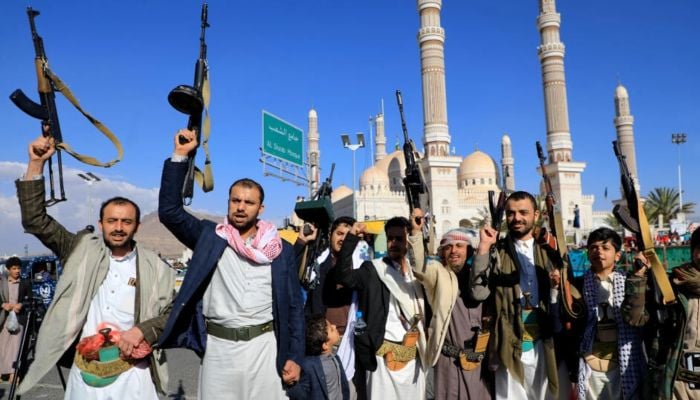
Armed Yemeni demonstrators take to the streets of the Huthi-controlled capital Sanaa, to show their support to Palestinians in the Gaza Strip on February 2, 2024. AFP Photo
The United States and Britain struck dozens of targets in
Yemen on Saturday in response to repeated attacks on shipping by Iran-backed
Huthi rebels that have disrupted global trade and put lives at risk.
The joint air raids in Yemen come a day after a separate
wave of unilateral American strikes against Iran-linked targets in Iraq and
Syria that were carried out in response to the killing of three US soldiers in
Jordan on January 28.
It is the third time that British and American forces have
jointly targeted the Huthis and the United States has also carried out a series
of air raids against them on its own, but the rebels' attacks have persisted.
The latest strikes hit "36 Huthi targets across 13
locations in Yemen in response to the Huthis' continued attacks against
international and commercial shipping as well as naval vessels transiting the
Red Sea," the United States, Britain and other countries that provided
support for the operation said in a statement.
US Defense Secretary Lloyd Austin said the strikes "are
intended to further disrupt and degrade the capabilities of the Iranian-backed
Huthi militia to conduct their reckless and destabilizing attacks."
"Coalition forces targeted 13 locations associated with
the Huthis' deeply buried weapons storage facilities, missile systems and
launchers, air defense systems, and radars," he said in a statement.
Neither Austin nor the joint statement identified the
specific places that were hit, but the Huthis' Al-Massirah television said
Sanaa and other locations were targeted.
Meeting 'escalation with escalation'
Britain's Defense Ministry said Royal Air Force Typhoon
warplanes struck targets including two ground control stations used to operate
both attack and reconnaissance drones.
US forces earlier Saturday separately carried out strikes
against six Huthi anti-ship missiles that were "prepared to launch against
ships in the Red Sea," the Central Command (CENTCOM) said.
The military command also said Saturday that US forces shot
down eight drones in and near Yemen the day before and destroyed four more
before they could be launched.
The Huthis began targeting Red Sea shipping in November,
saying they were hitting Israel-linked vessels in support of Palestinians in
Gaza, which has been ravaged by the Israel-Hamas war.
US and UK forces responded with strikes against the Huthis,
who have since declared American and British interests to be legitimate targets
as well.
Huthi spokesman Nasr al-Din Amer said following the Saturday
strikes that "either there is peace for us, Palestine and Gaza, or there
is no peace and no safety for you in our region."
"We will meet the escalation with escalation," he
wrote on social media.
Strikes in Iraq, Syria
Anger over Israel's devastating campaign in Gaza -- which
began after an unprecedented Hamas attack on October 7 -- has grown across the
Middle East, stoking violence involving Iran-backed groups in Lebanon, Iraq,
Syria and Yemen.
Last weekend, a drone slammed into a base in Jordan, killing
three US soldiers and wounding more than 40 -- an attack Washington blamed on
Iran-backed forces.
US and allied troops have been attacked more than 165 times
in Iraq, Syria and Jordan since mid-October, but the soldiers killed on January
28 were the first to die from hostile fire in the Middle East during that
period.
The United States responded Friday with strikes against
dozens of targets at seven Tehran-linked facilities in Iraq and Syria, but did
not hit Iranian territory.
Both the Iraqi and Syrian governments condemned the Friday
strikes, while Tehran said they would "have no result other than
intensifying tension and instability."
Diplomatic sources meanwhile said the UN Security Council
would convene Monday, after Russia called for a meeting "over the threat
to peace and safety created by US strikes on Syria and Iraq."
But British Foreign Secretary David Cameron has said Tehran
is ultimately responsible for the violence, telling the Sunday Times in an
interview that "we need to send the clearest possible signal to Iran that
what they're doing through their proxies is unacceptable."
"You created them, you backed them, you financed them,
you provided them with weapons, and you will ultimately be held accountable for
what they do," Cameron said.
/KN/

