Pakistan holds election tainted by rigging claims
Online Desk
08 Feb 2024 09:55 AM
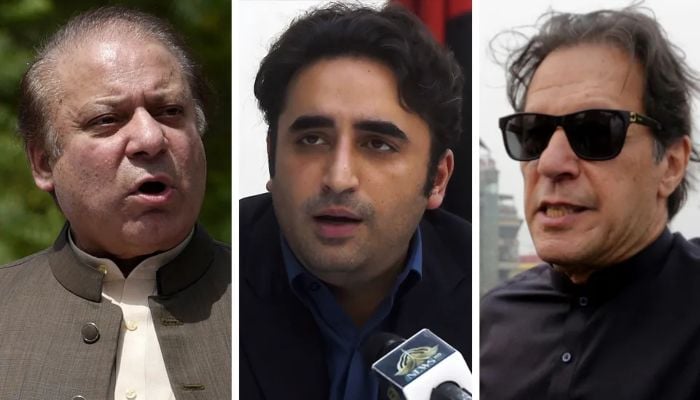
Nawaz Sharif (left) and Bilawal Bhutto can stand - but Imran Khan (right) is in jail and can't run. BBC Photo
Tens of millions of Pakistanis are heading to the polls to
vote in a new government amid soaring inflation, rising violence and claims of
rigging, BBC reports.
The election comes almost two years since the previous prime
minister, cricketer-turned-politician Imran Khan, was ousted in a no-confidence
vote.
Three-time PM Nawaz Sharif is on the ballot. Many analysts
say it's Pakistan's least credible election yet.
Pakistan also suspended mobile services minutes before
voting began.
Both calls and data services have been suspended, though
Wifi networks still appear to be working.
An interior ministry spokesman said the measure was
warranted for security reasons, citing recent incidents of terror in the
country.
Bomb blasts killed 28 people in the restive Balochistan
province on Wednesday, a day before the vote.
Strict rules around election coverage - including what can
be said about candidates, campaigning and opinion polls - remain in place until
the end of voting at 1700 local time (1200 GMT). Results have to be released
within two weeks.
As many as 128 million people are registered to cast their
votes, with almost half under the age of 35.
They will choose between more than 5,000 candidates - of
whom just 313 are women.
The Pakistan Muslim League (Nawaz) (PML-N) and the Pakistan
People's Party (PPP) were considered the two major parties going into the vote.
However, picking out candidates from Khan's Pakistan
Tehreek-e-Insaf (PTI) party has been made more difficult, after it was banned
from using the cricket bat symbol under which all its candidates run. Electoral
symbols play a key role in a country where more than 40% are unable to read.
The PTI allege other tactics have been used to prevent their
candidates winning seats as well, including being locked up, banned from
holding rallies and forced underground.
Khan was jailed on corruption charges and is barred from
standing. He is serving at least 14 years in prison, having been sentenced in
three separate cases in the space of five days last week. He still faces some
170 charges in different cases, his lawyers say. The PTI alleges interference
by Pakistan's powerful military, with whom Khan is said to have fallen out
before his fall from favour.
But people will be able to vote for Nawaz Sharif - the PML-N
leader, who at the time of the last election was beginning a sentence for
corruption.
The former PM was ousted in a 1999 military coup and had his
third term cut short in 2017 - but he recently returned from self-imposed exile
and had his lifetime ban on holding office, along with his criminal record,
wiped clean at the end of last year, allowing him to stand for what would be a
record fourth term.
However, whether any party can win a majority - which
requires 169 seats in the 336-seat National Assembly - is not yet clear.
Millions have been hit hard by the country's economic woes,
which were exacerbated by devastating floods in 2022. Inflation is soaring, and
people are struggling to pay their bills.
Across the country rising violence is also a concern.
According to the Islamabad-based Center for Research and
Security Studies (CRSS), 2023 saw violent incidents increase for the third year
in a row in Pakistan, with the most recorded fatalities - including security
forces, militants and civilians - since 2017.
Being involved in politics itself has proved dangerous. On
Wednesday - less than 24 hours before the first voters cast their ballots - two
separate attacks on candidates' offices left more than 28 people dead in
Balochistan province.
Officials are also aware there could be further attacks on
voting day itself.
Border crossings with Afghanistan and Iran will be closed
for cargo and pedestrians on Thursday to "ensure full security"
during polling, a spokesman from Pakistan's foreign ministry said. Tens of
thousands of military troops and paramilitary soldiers have also been deployed
to polling stations across the country.
The Election Commission of Pakistan has categorised half of
the 90,675 polling stations as either "sensitive", meaning there is a
risk of violence, or "most sensitive", indicating a higher risk. The
classifications are based on the region's security situation and history of
electoral violence.
A high turnout will be key to the PTI's chances, many
analysts say. How to tackle, and who to blame for, the country's economic
crisis will be high in voters' minds.
/KN/

