Israel PM orders troops to prepare for push into Rafah
AFP
08 Feb 2024 13:32 PM
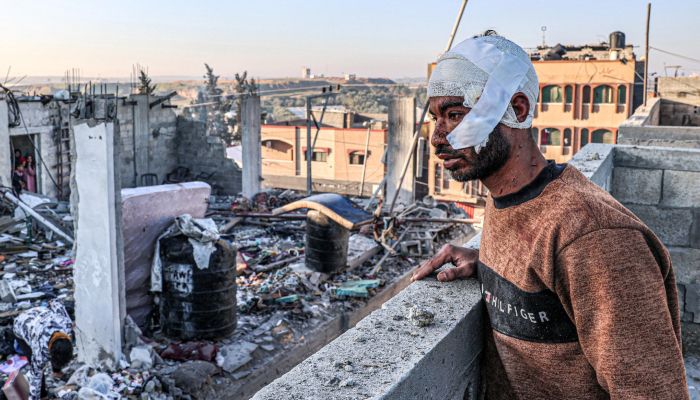
An injured man looks on while standing next to the rubble of a destroyed building following an Israeli bombardment in Rafah
Israeli Prime Minister Benjamin Netanyahu has ordered troops
to prepare to enter the overcrowded Gazan city of Rafah, even as a new round of
talks aimed at securing a truce with Hamas were set to open Thursday in Cairo.
Netanyahu announced the order after rejecting Hamas's
response to a ceasefire proposal at the centre of intense recent diplomatic
efforts, though visiting US Secretary of State Antony Blinken insisted on
Wednesday that he still saw "space for agreement to be reached".
Concerns were mounting, meanwhile, for the hundreds of
thousands of Palestinians who have sought refuge in Rafah along the Egyptian
border, with UN chief Antonio Guterres warning a military push into the city
"would exponentially increase what is already a humanitarian
nightmare".
In televised remarks Wednesday, Netanyahu said he had
ordered troops to "prepare to operate" in the city and that
"total victory" over Hamas was just months away.
Regarding the ceasefire proposal, he added: "Giving in
to the bizarre demands of Hamas that we have just heard will... only invite
another massacre."
Blinken, who is on yet another trip to the region to press
for a truce, told reporters in Tel Aviv that Hamas's counter-proposal at least
offered an opportunity "to pursue negotiations".
"While there are some clear non-starters in Hamas's
response, we do think it creates space for agreement to be reached, and we will
work at that relentlessly until we get there," Blinken said, hours after
meeting Netanyahu.
More talks
A new round of negotiations aimed at achieving
"calm" in Gaza and a prisoner-hostage exchange was set to open
Thursday in Cairo, an Egyptian official said.
Cairo was urging "both parties to show the necessary
flexibility" to make a deal, the official added, speaking on condition of
anonymity.
A Hamas source with knowledge of the matter confirmed that
the Palestinian group had agreed to the talks with the goals of "a
ceasefire, an end to the war and a prisoner exchange deal".
The war in Gaza was triggered by Hamas's unprecedented
attack on Israel on October 7, which resulted in the deaths of about 1,160
people, mostly civilians, according to an AFP tally based on official Israeli
figures.
Israel vowed to eliminate Hamas in response and launched air
strikes and a ground offensive that have killed at least 27,708 people, mostly
women and children, according to the Gaza health ministry.
The ministry said Thursday morning that another 109 people
had been killed in overnight strikes.
Militants also seized around 250 hostages on October 7.
Israel says 132 remain in Gaza, of whom 29 are believed to have died.
The fate of the hostages has gripped Israeli society, and
while Netanyahu has repeatedly insisted that military pressure is the only way
to bring them home, he has faced mounting calls to strike a deal.
Addressing the prime minister, Adina Moshe, one of the
hostages released as part of a temporary ceasefire deal brokered in November,
told a press conference in Tel Aviv: "Everything is in your hands."
"And I'm very afraid and very concerned that if you
continue with this line of destroying Hamas, there won't be any hostages left
to release," she added.
Fears for Rafah
As Israel prepared to press further south, fears were also
growing for the displaced Palestinian civilians thronging Rafah, pressed
against Gaza's southern border with Egypt.
More than half of Gaza's 2.4 million people are estimated to
have sought safety in the city.
"Their living conditions are abysmal -- they lack the
basic necessities to survive, stalked by hunger, disease and death," UN
humanitarian chief Martin Griffiths said in a statement.
"As the war encroaches further into Rafah, I am
extremely concerned about the safety and well-being of families which have
endured the unthinkable in search of safety."
Blinken stopped short of calling on Israel not to move on
the city, but did voice concern at the new push, saying any "military
operation that Israel undertakes needs to put civilians first and
foremost".
The war in Gaza has sparked a surge in violence across the
region, largely by Iran-backed groups operating in solidarity with Hamas,
drawing retaliatory attacks not only by Israel but also the United States and
its allies.
An American air strike in Iraq on Wednesday killed a senior
commander from a pro-Iran armed group who was "responsible for directly
planning and participating in attacks on US forces", the US Central
Command said.
The strike came after Washington last week launched a wave
of attacks on Iran-linked targets in Iraq and Syria following the killing of
three American troops in neighbouring Jordan.
In Lebanon, state media reported that Israeli strikes on a
southern village killed one civilian and wounded two others on Wednesday.
Since October 7, the Lebanese-Israeli border has seen
near-daily exchanges of fire between Israel and the Iran-backed Hamas ally
Hezbollah.
International Crisis Group president Comfort Ero warned
Wednesday that the hostilities around the region increased the possibility of
the situation boiling over.
"I think the big three -- Iran, Israel and the US -- do
not want to see escalation," she told AFP in Washington. "But we are
also seeing that every day we're one step closer to a major
miscalculation."
/KN/

