Trump ordered to pay $354m to New York for lying to banks
Online Desk
17 Feb 2024 12:55 PM
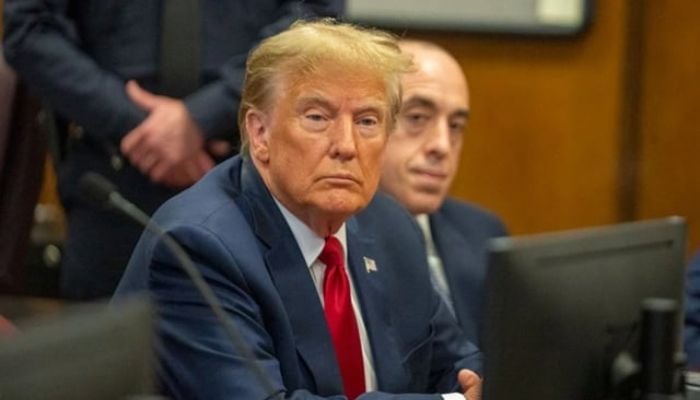
Former US President Donald Trump must pay nearly $355m
(£281m) to New York state for lying about the values of his properties, a judge
has ruled.
Judge Arthur Engoron also banned him from serving as a
company director or taking out loans from banks in the state for three years,
BBC reports.
The New York real estate mogul escaped having some of his
companies dissolved, which could have meant bankruptcy.
Speaking from his Florida estate, Trump said he would appeal
the ruling.
"A crooked New York state judge just ruled I have to
pay a fine for $350m for having built a perfect company," the former
president said from Mar-a-Lago on Friday, calling the ruling a political witch
hunt.
"It's a very sad day for - in my opinion - the
country."
In the ruling on Friday, Judge Engoron referred to previous
allegations of wrongdoing in justifying the large amounts he ordered the
defendants to pay, writing that they "are likely to continue their
fraudulent ways" unless he imposed a "significant" penalty.
He made specific reference to the Trump Organization's
conviction in a criminal tax fraud case in 2022, where a jury found it had
enriched its top executives with off-the books benefits for more than a decade.
"Their complete lack of contrition and remorse borders
on pathological," Judge Engoron wrote in an at times scathing 92-page
decision.
Later he said: "The frauds found here leap off the page
and shock the conscience."
Still, Trump's empire was spared from one of the worst
potential outcomes - the cancellation of its business licenses, known as the
corporate death penalty.
Instead, the judge ordered two tiers of oversight - an
independent monitor to report to the court for up to three years and a separate
independent director of compliance to be installed.
The judge is also requiring Trump pay interest on the
profits he made by committing the fraud (known as "prejudgment
interest"), which could bring the final amount penalty total to around
$450m.
Along with what Trump has been ordered to pay, his two adult
sons and co-defendants, Donald Jr and Eric, must each pay $4m. They are barred
for two years from doing business in New York, while another co-defendant,
Allen Weisselberg, the former chief financial officer of the Trump
Organization, has been ordered to pay $1m.
Additionally, Trump, his company, and its affiliates cannot
apply for loans in New York for three years.
Both of Trump's sons denounced the ruling on social media,
with Donald Jr claiming the judgment was politically motivated and Eric calling
the judge "a cruel man".
In her civil case, New York Attorney General Letitia James,
a Democrat, had accused all four defendants and the wider Trump Organization of
massively inflating property values and lying on financial statements so they
could borrow large sums of money at favourable interest rates. She had asked
for a fine of $370m.
Speaking on Friday, she said: "There cannot be
different rules for different people in this country, and former presidents are
no exception."
"Donald Trump may have authored the art of the deal,
but he perfected the art of the steal," she told a news conference.
In September, Judge Engoron ruled Trump was liable for
business fraud, finding he had misrepresented his wealth by hundreds of
millions of dollars.
In one instance, the judge found Trump's financial
statements had wrongly claimed that his Trump Tower penthouse was almost three
times its actual size.
The subsequent 43-day trial that took place late last year
and included testimony from 40 witnesses, focused mostly on determining
penalties against Trump.
Judge Ergoron's ruling lays out in detail his reasoning,
often diving deep into finance and accounting practices and directly addressing
testimony from experts and witnesses.
"In order to borrow more and at lower rates, defendants
submitted blatantly false financial data to the accountants, resulting in
fraudulent financial statements," he wrote. "When confronted at trial
with the statements, defendants' fact and expert witnesses simply denied
reality, and defendants failed to accept responsibility."
Judge Engoron may have made a thorough record expecting that
Trump would appeal, legal experts told the BBC.
Trump vehemently denied wrongdoing throughout the trial. In
a six-minute speech during closing arguments in January, Trump declared himself
an "innocent man" and called the case a "fraud on me".
And the former president said repeatedly that he paid his
lenders, which meant there was no crime.
While in his ruling Judge Engoron acknowledged that no banks
were hurt, he added that "the next group of lenders to receive bogus
statements might not be so lucky".
The latest penalty comes on top of the $83.3m Trump owes
writer E Jean Carroll in a separate defamation case. But while the amount is
high, it is not expected to bankrupt a man whose total net worth has been
estimated at $2.6bn.
/KN/

