Indian female medics speak out after brutal murder
AFP
21 Aug 2024 13:32 PM
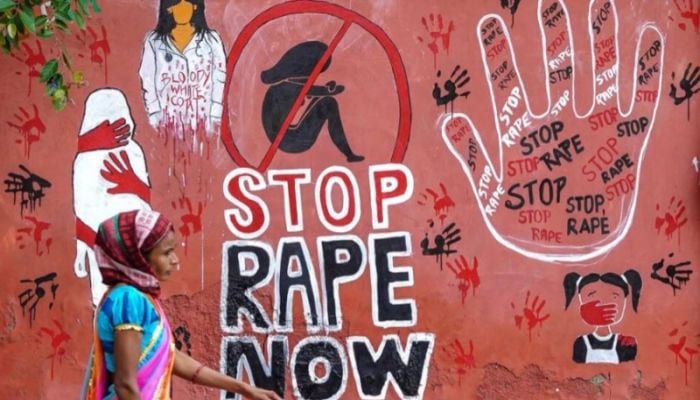
A woman walks past a mural painted on a wall in Ajmer condemning the rape and murder of a doctor in India's West Bengal state. AFP Photo
Saving lives was the childhood dream for 28-year-old Indian doctor Radhika, but after the brutal rape and murder of a colleague her own safety has increasingly become a top concern.
Earlier this month, at the government-run hospital where Radhika works in the eastern city of Kolkata, the battered and bloodied body of a 31-year-old woman doctor was found, sparking outrage.
One man has been detained, but the attack has focused anger on the lack of measures for female doctors to work without fear, and triggered protests and medical strikes.
"I was on night duty just two days before this incident," Radhika said at Kolkata's R.G. Kar Medical College and Hospital.
"What she did is what any of us do -– resting whenever, wherever we can".
The murdered doctor -- who has not been formally named but is being called "Abhaya", or "fearless" by protesters -- was found in the teaching hospital's seminar hall, suggesting she had gone there for a break during a long shift.
Radhika, whose name has been changed for fear of repercussions at her work, said conditions such as long working hours -- with barely any time to eat or rest -- were not unusual.
"This could have been any of us, and this still can be any of us," she added.
Attacks all too common
Tens of thousands of ordinary Indians have joined protests, channelling anger not only at the chronic issue of violence against women, but also at the failure to provide secure working conditions for them.
According to the philanthropic organisation Dasra, women make up nearly 30 per cent of doctors in India and 80 per cent of nursing staff.
India's Supreme Court on Tuesday ordered a national task force to examine how to bolster security for healthcare workers, saying the brutality of the killing had "shocked the conscience of the nation".
"The lack of institutional safety norms at medical establishments, against both violence and sexual violence against medical professionals, is a matter of serious concern," the court order read.
It highlighted a lack of CCTV cameras and a failure to screen visitors to hospitals for weapons.
Medical superintendent Indira Kabade, who works at KC General Hospital in the southern city of Bengaluru, said she worries her staff can get home safely.
"We never know if anyone is following them from the hospital," said Kabade, adding she and many female colleagues want "airport-like security", including police posted inside the campus.
"Despite us working non-stop to save lives, there is a need to rethink safety at workplace," Kabade said.
The gruesome nature of the doctor's killing has invoked comparisons with the horrific 2012 gang rape and murder of a young woman on a Delhi bus.
Nearly 90 rapes a day were reported in 2022 in the country of 1.4 billion people.

