These countries could lose the most, if US stops aid
Online Desk
27 Feb 2025 17:26 PM
The US Agency for International Development, Washington's primary humanitarian aid agency, has been a top target of a government reduction program spearheaded by billionaire and Trump ally Elon Musk since President Donald Trump took office on January 20, reports Reuters.
Hours after he was sworn in, Trump ordered a 90-day pause to all US foreign assistance pending assessments of efficiencies and consistency with his foreign policy. Four days later, on January 24, the US State Department issued a "stop-work" order for all existing foreign assistance and paused new aid with the exception of waivers for military financing for Israel and Egypt. While the government gave an exemption for emergency food assistance and issued waivers for certain life-saving aid, uncertainty around most other programs has put thousands of jobs and millions of dollars' worth of aid material in jeopardy.
The effects of shutting foreign aid down permanently could have impacts globally, especially for countries in Africa and the Middle East. The US has contributed the largest foreign assistance among countries, according to the Organisation for Economic Cooperation and Development.
The US provides the largest share of assistance
Net disbursements of official development assistance by OECD developed countries.
Why does USAID matter?
Foreign assistance is provided by different agencies of the US government. The US Agency for International Development (USAID) was the primary foreign assistance agency between 2014 and 2024. The agency disbursed, or spent, $314.3 billion out of the total $635.2 billion in this period. The State Department disbursed $175 billion. Obligations are money that was owed.
USAID accounted for half of foreign aid obligations and disbursements
Foreign assistance by managing agency between 2014 and 2024. Obligations refer to money that was promised but not yet spent, while disbursements refer to money spent.
The majority of USAID programs across the world are non-military in nature. Nearly one-third of all disbursements were for programs in the health sector. Aiding communities living with HIV or AIDS, providing sustainable access to drinking water and sanitation services, improving maternal and child health were among the top programs.
The agency also disbursed a substantial amount to provide food, water, shelter, healthcare and other such services for communities affected by natural and human-made disasters such as hurricanes, earthquakes, drought and wars.
Most of USAID's assistance goes to health and humanitarian causes
The US state and defense departments provide most of their assistance to peace and security measures.
Programs in the Peace and Security sector received the most assistance given by the Department of State and the Department of Defense. The Stabilisation operations and security sector reform program, which was the top program for the sector, attempts to stabilise conflict-affected regions and help improve a country's security institutions like the military, police, and intelligence services.
Reliance on the US for foreign assistance
As many as 31 countries, the majority in the Asia and Oceania and Sub-Saharan Africa regions, were reliant on the United States for at least one-fourth of their total foreign aid. The Marshall Islands, Micronesia, and Thailand in Asia and Botswana and Eswatini in Sub-Saharan Africa were reliant on the US for over half of their foreign aid.
Some countries rely on the US for more than 50% of their foreign assistance
Share of foreign assistance received from the US between 2014 and 2023
Different regions, different priorities
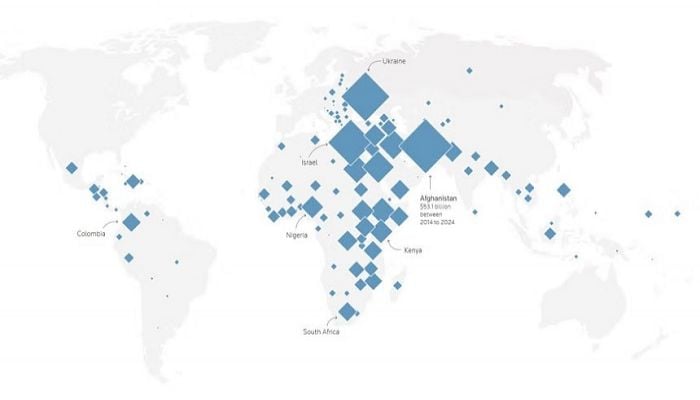
The Middle East and North Africa region received nearly half of the aid disbursed for the Peace and Security sector. Israel, Afghanistan and Egypt were the top beneficiaries. The Trump administration exempted military aid to Israel and Egypt when it first decided to pause all foreign assistance.
The Sub-Saharan Africa region, which has received a bulk of the aid disbursed for the Health and Humanitarian Assistance sectors, may not be so lucky. Due to the sudden freeze in aid, anti-malaria programs in Kenya and Ghana have come to a standstill. They had received $434 million and $334 million respectively to combat the vector-borne disease. The vast majority of the world's 597,000 malaria deaths in 2023 were African children aged under five years old, the WHO had said in December last year.
Although HIV/AIDS programs have been exempted from the freeze, the uncertainty around the future of the programs has caused widespread concerns. The United Nations AIDS agency has said that more than 6 million people could die from the disease in the next four years if funding is pulled from all programs. South Africa, Kenya and Tanzania have received the most aid to combat AIDS.
Ukraine, which has been dependent on the US to rebuild its economy after its war with Russia, is likely to be affected as well. It has received more than $28 billion in assistance for Economic Development sector, nearly 90% of the total aid for the sector received by Europe and Eurasia.
Peace and security is the largest sector, with most funding going to the Middle East and North Africa
Other sectors such as health and humanitarian causes were more funded in Sub-Saharan Africa, or in world programs.
Region by region breakdown
The charts below show the four countries which have received the most foreign aid from the United States, in each region, and the five programs for which the most aid was disbursed.
Middle East and North Africa
Peace and security was the top sector for US foreign assistance in the Middle East and North Africa region

