How real is the risk of nuclear war between India and Pakistan?
Online Desk
14 May 2025 16:52 PM
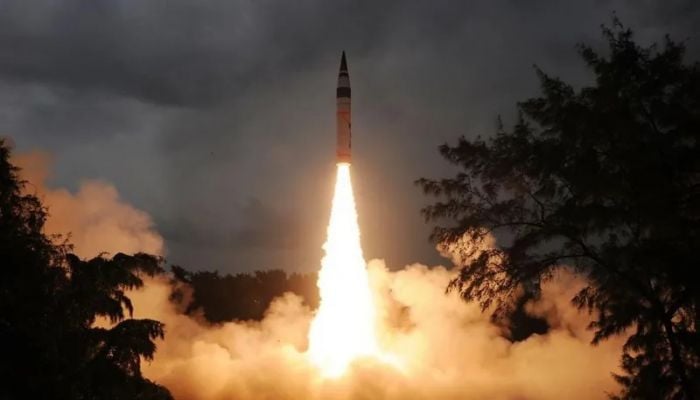
In the latest India-Pakistan stand-off, there were no ultimatums, no red buttons.
Yet the cycle of military retaliation, veiled signals and swift international mediation quietly evoked the region's most dangerous shadow. The crisis didn't spiral towards nuclear war, but it was a reminder of how quickly tensions here can summon that spectre, reports BBC.
Even scientists have modelled how easily things could unravel. A 2019 study by a global team of scientists opened with a nightmare scenario where a terrorist attack on India's parliament in 2025 triggers a nuclear exchange with Pakistan.
Six years later, a real-world stand-off - though contained by a US-brokered ceasefire on Saturday - stoked fears of a full-blown conflict. It also revived uneasy memories of how fragile stability in the region can be.
As the crisis escalated, Pakistan sent "dual signals" - retaliating militarily while announcing a National Command Authority (NCA) meeting, a calculated reminder of its nuclear capability. The NCA oversees control and potential use of the country's nuclear arsenal. Whether this move was symbolic, strategic or a genuine alert, we may never know. It also came just as US Secretary of State Marco Rubio reportedly stepped in to defuse the spiral.
President Trump said the US didn't just broker a ceasefire - it averted a "nuclear conflict". On Monday, in an address to the nation, Indian Prime Minister Narendra Modi said: "[There] is no tolerance for nuclear blackmail; India will not be intimidated by nuclear threats.
"Any terrorist safe haven operating under this pretext will face precise and decisive strikes," Modi added.
India and Pakistan each possess about 170 nuclear weapons, according to the think-tank Stockholm International Peace Research Institute (Sipri). As of January 2024, Sipri estimated there were 12,121 nuclear warheads worldwide. Of these, about 9,585 were held in military stockpiles, with 3,904 actively deployed - 60 more than the previous year. The US and Russia together account for more than 8,000 nuclear weapons.
The bulk of both India's and Pakistan's deployed arsenals lies in their land-based missile forces, though both are developing nuclear triads capable of delivering warheads by land, air and sea, according to Christopher Clary, a security affairs expert at the University at Albany in the US.
"India likely has a larger air leg (aircraft capable of delivering nuclear weapons) than Pakistan. While we know the least of Pakistan's naval leg, it is reasonable to assess that India's naval leg is more advanced and more capable than Pakistan's sea-based nuclear force," he told the BBC.
One reason, Mr Clary said, is that Pakistan has invested nowhere near the "time or money" that India has in building a nuclear-powered submarine, giving India a "clear qualitative" edge in naval nuclear capability.
Since testing nuclear weapons in 1998, Pakistan has never formally declared an official nuclear doctrine.
India, by contrast, adopted a no-first-use policy following its own 1998 tests. But this stance has shown signs of softening. In 2003, India reserved the right to use nuclear weapons in response to chemical or biological attacks - effectively allowing for first use under certain conditions.
Further ambiguity emerged in 2016, when then–defence minister Manohar Parrikar suggested India shouldn't feel "bound" by the policy, raising questions about its long-term credibility. (Parrikar clarified that this was his own opinion.)
The absence of a formal doctrine doesn't mean Pakistan lacks one - official statements, interviews and nuclear developments offer clear clues to its operational posture, according to Sadia Tasleem of Carnegie Endowment for International Peace.
Pakistan's nuclear threshold remains vague, but in 2001, Khalid Kidwai - then head of the Strategic Plans Division of the NCA - outlined four red lines: major territorial loss, destruction of key military assets, economic strangulation or political destabilisation.
In 2002, then-president Pervez Musharraf clarified that "nuclear weapons are aimed solely at India", and would only be used if "the very existence of Pakistan as a state" was at stake.
In his memoir, former US Secretary of State Mike Pompeo wrote that he was jolted awake at night to speak with an unnamed "Indian counterpart" who feared Pakistan was preparing to use nuclear weapons during the 2019 stand-off with India.
Around the same time, Pakistani media quoted a senior official issuing a stark warning to India: "I hope you know what the [National Command Authority] means and what it constitutes. I said that we will surprise you. Wait for that surprise… You have chosen a path of war without knowing the consequences for the peace and security of the region."
During the 1999 Kargil War, Pakistan's then-foreign secretary Shamshad Ahmed warned that the country would not "hesitate to use any weapon" to defend its territory. Years later, US official Bruce Riedel revealed that intelligence indicated Pakistan was preparing its nuclear arsenal for possible deployment.
But there is scepticism on both sides over such claims.
Former Indian high commissioner to Pakistan Ajay Bisaria wrote in his memoir that Pompeo overstated both the risk of nuclear escalation and the US role in calming the conflict in 2019. And during Kargil, Pakistan "knew the Indian Air Force wouldn't cross into its territory" - so there was no real trigger for even an implicit nuclear threat, insist Pakistani analysts.
"Strategic signalling reminds the world that any conflict can spiral - and with India and Pakistan, the stakes are higher due to the nuclear overhang. But that doesn't mean either side is actively threatening nuclear use," Ejaz Haider, a Lahore-based defence analyst, told the BBC.
But nuclear escalation can happen by accident too. "This could happen by human error, hackers, terrorists, computer failures, bad data from satellites and unstable leaders," Prof Alan Robock of Rutgers University, lead author of the landmark 2019 paper by a global team of scientists, told the BBC.
In March 2022, India accidentally fired a nuclear-capable cruise missile which travelled 124km (77 miles) into Pakistani territory before crashing, reportedly damaging civilian property. Pakistan said India failed to use the military hotline or issue a public statement for two days. Had this occurred during heightened tensions, the incident could have spiralled into serious conflict, experts say. (Months later, India's government sacked three air force officers for the "accidental firing of a missile".)
Yet, the danger of nuclear war remains "relatively small" between India and Pakistan, according to Mr Clary.
"So long as there is not major ground combat along the border, the dangers of nuclear use remain relatively small and manageable," he said.
"In ground combat, the 'use it or lose it' problem is propelled by the possibility that your ground positions will be overrun by the enemy." ('Use it or lose it' refers to the pressure a nuclear-armed country may feel to launch its weapons before they are destroyed in a first strike by an adversary.)
At least 48 Palestinians have been killed in a series of Israeli air strikes in northern Gaza overnight, a local hospital says.
The Indonesian hospital reported that 22 children and 15 women were among the dead after a number of homes in Jabalia town and refugee camp were hit. A video shared online appeared to show at least a dozen bodies on the floor there.
The Israeli military said it was looking into the reports. It had warned residents of Jabalia and neighbouring areas to evacuate on Tuesday night after a Palestinian armed group launched rockets into Israel.
It came as the UN's humanitarian affairs chief urged members of the UN Security Council to take action to "prevent genocide" in Gaza.
Speaking at a meeting in New York on Tuesday, Tom Fletcher accused Israel of "deliberately and unashamedly imposing inhumane conditions on civilians".
He called on Israel to lift its 10-week blockade on Gaza and criticised the Israeli-US plan to take over the distribution of humanitarian aid in the territory.
The Israeli ambassador to the UN, Danny Danon, told the council that foreign aid was being used to help Hamas's war effort.
Meanwhile, US Special Envoys Steve Witkoff and Adam Boehler said they would travel to Qatar for fresh negotiations on a possible ceasefire and hostage release deal.
Israel's Prime Minister, Benjamin Netanyahu, has threatened to expand its military offensive in Gaza this week unless Hamas agrees to release the 58 hostages it is still holding.
On Tuesday, a massive Israeli air strike on the European hospital's compound in southern Gaza killed at least 28 people, according to local officials.
Israeli media reports said the target was Mohammed Sinwar, who is believed to have become the leader of Hamas in Gaza after his brother Yahya was killed by Israeli forces last October.
The Israeli military described it as "a precise strike on Hamas terrorists who were operating in a command-and-control centre" underneath the hospital.
The Israeli military launched a campaign to destroy Hamas in response to an unprecedented cross-border attack on 7 October 2023, in which about 1,200 people were killed and 251 others were taken hostage.
At least 52,908 people have been killed in Gaza since then, according to the territory's Hamas-run health ministry.

