Japan reports tsunami waves along Pacific Coast
Online Desk
30 Jul 2025 11:36 AM । Update: 30 Jul 2025 11:41 AM
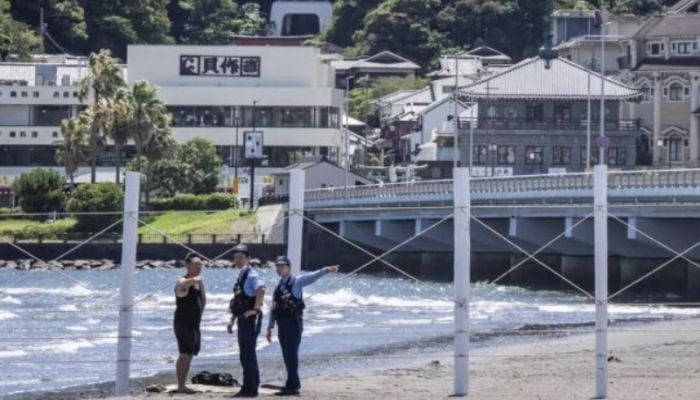
Police ask a man to leave a beach in Fujisawa city, Japan, after the tsunami warning. AFP Photo
The whole Pacific coast of Japan is now reporting tsunami waves, according to Japanese broadcaster NHK World.
Waves are now as high as 60cm (1.9ft) along some parts of the coast, including Kuji Port and Hamanaka town, according to NHK.
The size of the waves has grown steadily from 20cm (0.6ft) earlier this morning, and authorities say they could reach as high as 3 metres (9.8ft).
Tsunami warning advisories will be in place across Japan for at least the next 24 hours, the broadcaster said.
Japan reports that waves as high as 50cm (1.6 ft) were recorded at Ishinomaki Port, a major city in the Miyagi Prefecture on the east coast. Elsewhere, the first tsunami waves measured 20cm to 40cm (0.6 to 1.3 ft), but Japanese authorities say the second and third waves could be larger.
NHK World warned earlier that tsunami waves are stronger than ordinary waves, and a 50cm wave can carry a force of up to 200kg (440 pounds).
Japanese media report that the first tsunami waves of 30cm to 40cm (1 to 1.3 ft) have been observed in northern Hokkaido, including the following locations:
Tokachi Port
Nemuro Hanasaki
Hamanaka town
Kushiro Port
Erimo town
Foreign tourists visiting Japan have been advised to ask locals for help to find shelter and other assistance.
Staff at the still-stricken Fukushima nuclear plant in northeast Japan have been evacuated amid countrywide tsunami warnings, Al Jazeera reports.
“We have evacuated all workers and employees” at the Fukushima Daiichi plant, a spokeswoman for plant operator Tokyo Electric Power Company (TEPCO) told the AFP news agency, adding “no abnormality” had been observed at the site.
Fukushima went into meltdown in 2011 after a magnitude 9 earthquake struck off the coast of northeastern Japan, triggering a devastating tsunami that knocked out power and cooling systems at the plant, leading to the meltdown of three of the plant’s six reactors and causing the country’s worst nuclear accident.
University of Tokyo seismologist Sakai Shinichi told Al Jazeera that today’s earthquake and tsunami resemble a historic incident from 1952.
The powerful 1952 Severo-Kurilsk earthquake also struck off the coast of the Kamchatka Peninsula in Russia’s far east, causing extensive damage and a tsunami.
“We will have to wait for reports from Russia to determine the extent of the damage on the Kamchatka Peninsula. Tsunamis of [20-50] centimetres [0.6-1.6 ft] have been observed in Japan, but information is still insufficient, so the number may increase in the future,” Sakai said.
“In the past, large earthquakes have occurred off the coast of the Kamchatka Peninsula and the Kuril Islands, and the resulting tsunamis have reached Japan, causing widespread damage. For example, the 1952 earthquake,” he said.
A powerful magnitude 8.7 earthquake struck off Russia’s far-east coast at 8:25am local time on Wednesday (23:25 GMT on Tuesday), the US Geological Survey said.
Several people were injured in Russia’s far east during the earthquake, the TASS state news agency reported.
Residents were evacuated as tsunami waves flooded the Russian port town of Severo-Kurilsk, Russia’s Emergencies Ministry said.
Japan’s meteorological agency issued a tsunami advisory for much of its east coast, warning of waves of up to 3 metres (9.8 ft) high.
Tsunami warnings were also issued for Taiwan, the Philippines, Hawaii, Alaska’s Aleutian Islands and some parts of Indonesia, with advisories issued for much of the US West Coast.

