Thousands flee Aleppo as clashes between Syria’s army and SDF escalate
Online Desk
08 Jan 2026 14:38 PM
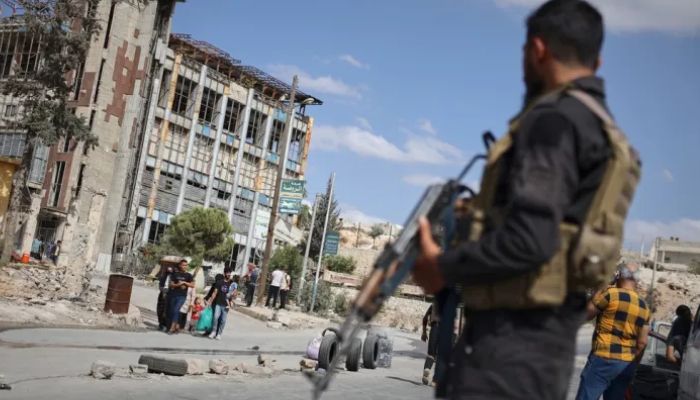
Several killed in fighting between Syrian army, Kurdish-led SDF in Aleppo
Tens of thousands of people have fled their homes in Syria’s Aleppo after the army declared two Kurdish neighbourhoods “closed military zones” amid the second day of clashes with the Kurdish-led Syrian Democratic Forces (SDF), Al Jazeera reports.
The directorate for social affairs said on Wednesday night that more than 45,000 people had been displaced from the city due to the fighting, most of them heading northwest towards the enclave of Afrin.
Many of the fleeing families left on foot through humanitarian corridors opened by the Syrian army for civilians to leave flashpoint areas. They carried what they could, unsure when or if they would return.
Some families were also ferried out on city buses.
“We fled the clashes, and we don’t know where to go … Fourteen years of war, I think that’s enough,” Ahmed, a 38-year-old man who only gave his first name, told the AFP news agency while carrying his son on his back.
Another displaced resident, 41-year-old Ammar Raji, said he and his family were “forced to leave because of the difficult circumstances”.
“I have six children, including two young ones … I am worried we will not return,” Raji said.
The clashes, which began on Tuesday and have killed nine people, according to an official, marked the fiercest fighting between the army and the SDF after the two sides failed to implement a March deal to integrate the Kurdish-led forces into Syria’s new state institutions.
Closed neighbourhoods
The Syrian Army Operations Command had said earlier in the day that all SDF “military sites” in the Sheikh Maqsoud and Ashrafieh neighbourhoods of Aleppo were “legitimate military targets” following the SDF’s “major escalation towards the neighbourhoods of Aleppo city and its perpetration of numerous massacres against civilians”.
It said the two neighbourhoods would be considered “closed military zones” as of 3pm local time (12:00 GMT) on Wednesday and told residents to leave through the humanitarian corridors.
Schools, universities and government offices in the city were also shut down on Wednesday, and authorities announced the suspension of flights to and from Aleppo airport until Thursday evening.
The SDF acknowledged a large deployment of Syrian army vehicles near the areas, labelling it a “dangerous indicator that warns of escalation and the possibility of a major war”.
Al Jazeera’s Resul Serdar, reporting from Aleppo, said while tens of thousands of people were seen gathering their belongings and leaving the neighbourhoods, many remained trapped amid the fighting.
“And once the clock hit 3pm … we have seen things rapidly escalate: the artillery shelling, the rocket firing, the gunfire – and with drones being involved,” Serdar said, adding that the situation in the city remained “extremely tense”.
Aleppo has seen some of the worst fighting of Syria’s civil war, he noted. “And once again, civilians are paying the price. What’s unfolding here is not just a local security incident; it reflects a deeper struggle over control, the legacy of civil war, and the unresolved political future of post-war Syria,” Serdar added.
Sectarian tensions
Both sides have blamed the other for triggering the violence, which broke out after United States-mediated talks this week between government officials and the main SDF commander stalled with “no tangible results” achieved, according to state media.
The SDF took control of large swaths of territory in Syria’s north and northeast during the country’s 14-year civil war, and its incorporation into state institutions has remained a point of contention since President Ahmed al-Sharaa took office a year ago.
The deal reached in March, in which the SDF agreed for “all civil and military institutions in northeastern Syria” to be merged into “the Syrian state, including border crossings, the airport, and oil and gas fields”, has yet to be carried out.
Syria’s Information Minister Hamza al-Mustafa accused the SDF of violating the agreement more than 100 times, and said at least 20 civilians have been killed in attacks over the past month.
“An urban city and major city like Aleppo cannot function under consistent threat for the daily life,” he told Al Jazeera.
“We are talking here about an agreement [that] has been signed and needs to be implemented. And until now, the SDF and the armed group inside this neighbourhood violated the agreement. And so … that’s [what] forced the government to secure the civilians and implement and restore the order on the ground,” he added.
In a statement, the SDF insisted that they had no presence in the neighbourhoods and claimed the areas “do not pose a military threat in any way”.
It also called on the Syrian army to “immediately halt the siege, bombardment and military offensive” and warned that the continuation of the hostilities could “turn Syria into an open battlefield again”.
The United Nations expressed concern, with a spokesperson for Secretary-General Antonio Guterres calling “on all actors to immediately deescalate, exercise maximum restraint and take all measures to prevent further harm to civilians”.
The spokesperson also urged “flexibility and goodwill” and the prompt resumption of negotiations to implement the March deal.
Muhanad Seloom, an assistant professor in critical security studies at the Doha Institute for Graduate Studies, told Al Jazeera that the fighting in Aleppo signals that the “honeymoon period” following the fall of longtime leader Bashar al-Assad in December 2024 may be over.
“What we are looking at is a race between integration and disintegration,” said Seloom, referring to Damascus’s struggle to bring minority communities into national institutions, and the danger it poses to the fragile Syrian state.
Analysts also say al-Sharaa’s efforts to amalgamate power and quell sectarian tensions among the numerous groups across Syria after al-Assad’s fall have not been helped by Israel.
Over the past year, Israel has launched more than 600 air, drone and artillery attacks across Syria, averaging nearly two a day, according to a monitoring group, as part of what experts say is a strategy to keep its neighbours weak.
But the US sees Syria as a crucial partner in the fight against ISIL or ISIS, and wants a strong government in Damascus to avoid the return of Iranian influence in the country.
Marie Forestier, a nonresident senior fellow for the Atlantic Council’s Syria Project, told Al Jazeera that the distance between Syrian, Israeli and US goals is “very difficult”, especially given that “Israel is doing everything to destabilise Syria”.

