Who is Liz Truss?
Online Desk
05 Sep 2022 18:10 PM
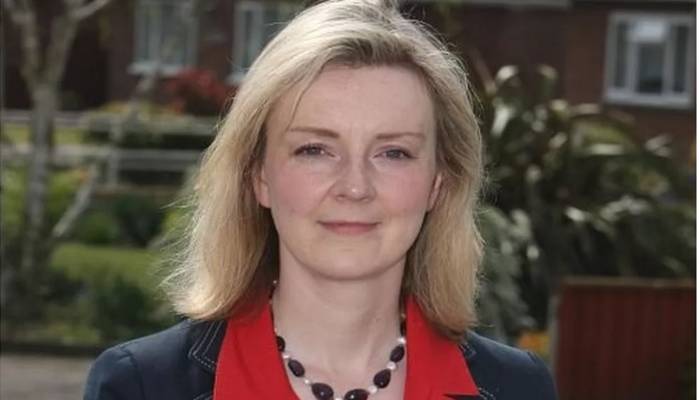
At the age of seven, Liz Truss played the role of Margaret Thatcher in her school's mock general election.
But unlike the prime minister, who won a huge majority in 1983, she did not prove a success, reports BBC.
Many years later, Ms Truss recalled: "I jumped at the chance and gave a heartfelt speech at the hustings, but ended up with zero votes. I didn't even vote for myself."
Thirty-nine years on, she is jumping at the chance to follow the Iron Lady's lead for real and become Conservative leader and prime minister.
The foreign secretary trailed ex-Chancellor Rishi Sunak in all five rounds of voting by Tory MPs.
But bookmakers have her as the clear favourite to win, having spent years building relationships with constituency associations and having remained loyal to Boris Johnson during the darkest days of his premiership.
Mary Elizabeth Truss was born in Oxford in 1975. She has described her father, a mathematics professor, and her mother, a nurse, as "left-wing".
As a young girl, her mother took on marches for the Campaign for Nuclear Disarmament, an organisation vehemently opposed to the Thatcher government's decision to allow US nuclear warheads to be installed at RAF Greenham Common, west of London.
Liz Truss: The basics
Age: 47
Place of birth: Oxford
Home: London and Norfolk
Education: Roundhay School in Leeds, Oxford University
Family: Married to accountant Hugh O'Leary with two teenage daughters
Parliamentary constituency: South West Norfolk
The family moved to Paisley, just west of Glasgow, when Ms Truss was four years old.
Speaking to BBC Radio 4's Profile, her brother said the family enjoyed playing board games, but the young Ms Truss hated losing and would often disappear rather than risk not winning.
The family later decamped to Leeds, where she attended Roundhay, a state secondary school. She has described seeing "children who failed and were let down by low expectations" during her time there.
Some of Ms Truss's contemporaries at Roundhay have disputed her account of the school, including Guardian journalist Martin Pengelly, who wrote: "Perhaps she is selectively deploying her upbringing, and casually traducing the school and teachers who nurtured her, for simple political gain."
Whatever her schooling, Ms Truss got to Oxford University, where she read philosophy, politics and economics and was active in student politics, initially for the Liberal Democrats.
At the party's 1994 conference, she spoke in favour of abolishing the monarchy, telling delegates in Brighton: "We Liberal Democrats believe in opportunity for all. We do not believe people are born to rule."
Westminster ambitions
At Oxford, Ms Truss switched to the Conservatives.
After graduating she worked as an accountant for Shell, and Cable & Wireless, and married fellow accountant Hugh O'Leary in 2000. The couple have two children.
Ms Truss stood as the Tory candidate for Hemsworth, West Yorkshire, in the 2001 general election, but lost. Ms Truss suffered another defeat in Calder Valley, also in West Yorkshire, in 2005.
But, her political ambitions undimmed, she was elected as a councillor in Greenwich, south-east London, in 2006, and from 2008 also worked for the right-of-centre Reform think tank.
Conservative leader David Cameron put Ms Truss on his "A-list" of priority candidates for the 2010 election and she was selected to stand for the safe seat of South West Norfolk.
But she quickly faced a battle against de-selection by the constituency Tory association, after it was revealed she had had an affair with Tory MP Mark Field some years earlier.
The effort to oust her failed and Ms Truss went on to win the seat by more than 13,000 votes.
She co-authored a book, Britannia Unchained, with four other Conservative MPs elected in 2010, which recommended stripping back state regulation to boost the UK's position in the world, marking her out as a prominent advocate of free market policies on the Tory benches.
During a BBC leadership debate, she was challenged about a comment in Britannia Unchained, describing British workers as "among the worst idlers in the world". She insisted she had not written it.
In 2012, just over two years after becoming an MP, she entered government as an education minister and in 2014 was promoted to environment secretary.
At the 2015 Conservative conference, Ms Truss was mocked for a speech in which she said, in an impassioned voice: "We import two-thirds of our cheese. That. Is. A. Disgrace."
Brexit U-turn
Less than a year later came arguably the biggest political event in a generation - the EU referendum.
Ms Truss campaigned for Remain, writing in the Sun newspaper that Brexit would be "a triple tragedy - more rules, more forms and more delays when selling to the EU".
However, after her side lost, she changed her mind, arguing that Brexit provided an opportunity to "shake up the way things work".
Under Theresa May's premiership, she served as justice secretary before moving on to become chief secretary to the Treasury.
When Boris Johnson became prime minister in 2019, Ms Truss was moved to international trade secretary - a job which meant meeting global political and business leaders to promote UK PLC.
In 2021, aged 46, she moved to one of the most senior jobs in government, taking over from Dominic Raab as foreign secretary.
In this role she has sought to solve the knotty problem of the Northern Ireland Protocol, by scrapping parts of a post-Brexit EU-UK deal - a move the EU fiercely criticised.
She secured the release of two British-Iranian nationals who had both been arrested and detained.
And when Russia invaded Ukraine in February she took a hard line, insisting all of Vladimir Putin's forces should be driven from the country.
But she faced criticism for backing people from the UK who wanted to fight in Ukraine.
'Opposed to handouts'
Ms Truss's campaign for the party leadership has not been free of controversy.
Pressed on how she would tackle the cost of living crisis, she has said she will focus her efforts on "lowering the tax burden, not giving out handouts".
She has been forced to scrap a plan to link public sector pay to regional living costs by a backlash from senior Tories who said it would mean lower pay for millions of workers outside London.
And she called Scotland's First Minister Nicola Sturgeon an "attention seeker", adding it was best to "ignore her".
However, polls suggest she is more popular among party members than her rival Rishi Sunak.
Some have suggested that Ms Truss, through her outfits - such as a fur hat and a white bow - is trying to emulate another Tory favourite - Mrs Thatcher.
Ms Truss has dismissed this, telling GB News: "It is quite frustrating that female politicians always get compared to Margaret Thatcher while male politicians don't get compared to Ted Heath."
But such comparisons are not, perhaps, an obvious disadvantage when it comes to garnering support from Conservative Party members.

