Children of the coast: Part 02
Child labour, child marriage on the rise
Abu Saleh Rony, back from coastal districts
09 Jan 2025 16:19 PM । Update: 09 Jan 2025 16:21 PM
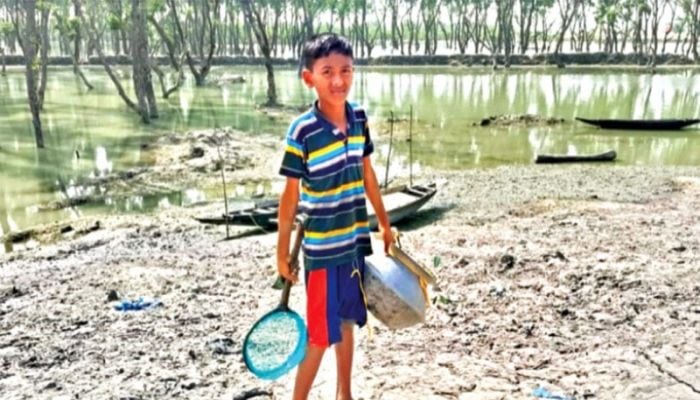
Azmir, a third-grade student, returns after fishing in the Sunderban adjacent Kholpotua River. Samakal Photo
Mrinal Rajbongshi, a resident of the coastal area in Satkhira, lost his life in a tiger attack in 2017 when he went to catch crabs in the Chunkori River near the Sunderbans. His death plunged his family living in the Vetkhali village of Shyamnagar upazila into a sea of despair.
After losing her husband unexpectedly, Kolpona Dheebor and her daughters started fishing in the nearby rivers. At the same time, she started looking for marriage prospects for her underage daughters one by one. In 2024, her youngest daughter Seema, a sixth-grade student, was married off.
Kolpona defended her decision to marry off her minor daughters as a way to pull the family out of poverty. She claims that her decision was influenced by her neighbours who urged her to marry off her daughters.
In the neighbouring Romjannogor Union, child labour was rife. Despite being enrolled as a fourth-grade student at the Kalinchi Government Primary School, Arif Hossain Abdullah spends his days as a fisherman and a boatman.
Arif's mother Sofura is homeless. When Arif was only a year old, his father left and started a new family elsewhere. In a bind, Sofura started miscellaneous day labour.
It is difficult to send Arif to school, she said. He has to cross a river to go to school every day. Moreover, she cannot afford private tutoring for him. Instead, he now works as a day labourer and earns around Tk 100-200 every day.
Such situations are seen often in most of the coastal districts and upazilas of the country. However, according to the Children Act 2013, National Children Policy 2011, National Education Policy 2010, National Child Labour Elimination Policy 2010, and other policies to ensure children's welfare, it is the state's duty to ensure a child's safety. In reality, the policies rarely have any practical effect.
Visiting the five coastal upazilas adjacent to the Sunderbans revealed that the authority has become more inert due to the political unrest gripping the nation. This has increased the number of child marriages. Climate change has influenced the lives of the people living in the coastal areas, intensifying poverty. Children have become the worst victims. In addition, adolescent girls are being deprived of proper reproductive healthcare. Many displaced families became climate refugees.
The alarming reality of dropouts
According to Satkhira District Education Office, the rate of students dropping out has increased in the year 2023 at Ashashuni, Kaliganj, and Shyamnagar Upazilas.
The number of dropouts in Kaliganj was 161, Shyamnagar 112, and Ashashuni 33. Usually, girls drop out between grades seven to nine to get married. On the other hand, boys drop out before the SSC examination, or after failing SSC.
According to a 2023 Bangladesh Bureau of Educational Information and Statistics (BANBEIS) report, there were more than 92 lakh students at the secondary level in 2019. However, that number has dropped to 81 lakh 66 thousand by 2023.
Meanwhile, research by the International Rescue Committee and DM Watch found that due to the adverse effects of climate change, 80 per cent of children in the coastal areas drop out of school after the primary level.
Recent trend
What is behind the recent trend of students dropping out of school? When asked, Shyamnagar Upazila's Burigoalini Forest Secondary School's Headmaster Ayub Ali told the Daily Samakal that poverty was the main reason for dropouts. There are many reasons for poverty in the coastal areas. Natural calamities lash the coastal areas often. Due to salt and brackish water, farming is difficult. As a result, locals live through uncertainties year-long. The poverty pushes them towards using their children for labour. Even the children become discouraged from continuing studies after the primary level.
Steps taken by authority
According to Shyamnagar Upazila Authority, 47 child marriages were stopped in the upazila from 2020 to November 19, 2024. 13 of those marriages were stopped in 2024 alone.
Upazila Nirbahi Officer Ronny Khatun told the Daily Samakal that the authority takes action as soon as it is informed about any child labour or child marriage. However, it is difficult for the authority alone to stop such occurrences. A social movement as well as awareness of the parents is also necessary.
Satkhira District Commissioner Mostak Ahmed said the situation regarding dropouts has come to his attention. All the education officials and related teachers are directed to contact the families of the dropouts. Hopefully, this measure will bear fruit.
Eminent lawyer ZI Khan Panna told the Daily Samakal that marginal people, including the residents of coastal areas, are living in desolate conditions. The main reason is economic. Most of the government's steps are centred around the capital and secretariat. This causes harm to the poor and very poor people. The state must take responsibility for children as per law. The future of children is bleak- this cannot be tolerated.

