Children of the coast: Last Part
Scarcity of drinking water jeopardises child health
Abu Saleh Rony, back from coastal districts
10 Jan 2025 19:11 PM । Update: 10 Jan 2025 19:14 PM
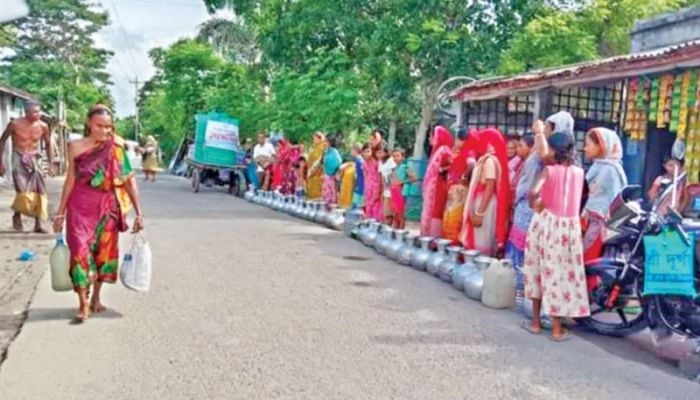
Villagers including children wait to collect water at Kalbari village of Shyamnagar. Samakal Photo
Gabura Union is an island adjacent to the Sunderbans, under the Shyamnagar upazila of Satkhira district. The coastal island is flanked by the rivers Kopotakkho and Kholpetua. Surrounded by water, the island suffers from a perpetual scarcity of safe drinking water.
The problem is exacerbated further in summer. Starting at the end of April, most tube wells become useless as the groundwater level drops far below their ability. Coastal children suffer the worst in this situation. Most of them drink less water than they optimally need.
Aside from the surface water, the groundwater is becoming salty as time goes by. To survive in this adverse situation, locals have taken measures to secure drinking water. Almost every house owns several large drums to collect and store rainwater. These drums were seen in several upazilas including Shyamnagar, Ashashuni, Kaliganj, Koyra, and Dakop. Measures to conserve drinking water were also seen at Forest Department camps or outposts adjacent to the Sunderbans.
Drinking water scarcity is a constant headache for nearly 3 crore 90 lakh people in 19 coastal areas. More than 13 lakh people in the five upazilas adjacent to the Sunderbans face such scarcity. The daily drinking water requirement of this populace is 38,42,136 litres. Only 35 per cent of this requirement is met by tubewell water in Koyra, 25 per cent in Shyamnagar, and 15 per cent in Kaliganj. The rest of the required water is collected from rainwater and local water bodies. People have to walk miles to find drinking water. Even some children have to skip school and go looking for water for their family.
Confirming the matter, Gabura Union Chairman GM Masudul Alam told the Daily Samakal, '15 villages of this union have a population of 48 thousand. Four villages have provisions for drinking water. The other 11 villages suffer a lot. Children could drink cow's milk. However, the lack of water has made rearing cattle difficult as well."
Child Health Specialist Dr ASM Alamgir Choudhury told the Daily Samakal, 'The physical harm (from lack of drinking water) is multidimensional. Dehydration, lethargy, Kidney and bowel function problems, skin and urethra infections, electrolyte imbalance, antibody function reduction as in problems in immune function may happen. These damages are long-term and become more apparent with age. Therefore, safe drinking water should be ensured for coastal people."
Situation at the coast
More than a thousand primary and secondary schools are situated at the five coastal upazilas adjacent to the Sunderbans, with nearly 2 lakh students. The level of arsenic in the tube wells of these schools is above the danger level. Due to this, most of the schools conserve rainwater in drums. Once that water runs out, water from ponds is collected and cleaned using potash alum.
However, some schools do not have any facilities for safe drinking water at all.
Minmoy Biswas, assistant teacher of Koyra Baniakhali Sunderban Primary School said, there are 66 students in the school. There is no provision for drinking water in the school. There is a tube well, but it fetches water full of salt and iron. Both children and teachers bring drinking water from home. They have to travel nearly 2 km to buy water.
Difficulty in farming and rearing cattle
The five upazilas are surrounded by nearly 20 rivers. The rivers are suitable for fishing, but not drinking. This water is too salty for farming. As a result of the high level of salt in the water, crop production in this area has fallen a lot. As the cattle and fowl cannot be given this salty water, rearing them has also become problematic.
Shyamnagar Nurnagar Union's farmer Md Weskuruni told the Daily Samakal that he is unable to provide drinking water for his goats, duck, and chicken. He added that he has to buy 30 litres of water daily from Nurnagar Bazar. The water itself costs Tk 15, while the transport cost is Tk 20.
Water: a costly commodity
A private water filtering plant was established at Paithali Kunduria of Ashashuni around 18 years ago. The water is filtered from a pond. People from 10-15 villages come to buy water from here every day. Around Tk 30-50 is spent to collect a month's water from the plant. This money is used to pay for the plant's operating costs.
A similar situation was seen in other upazilas. Many non-government organisations have taken up initiatives to supply drinking water to villagers. This is also causing harm to children indirectly as their families are going through financial stress to buy water.
Waiting for rain
Coastal people drink rainwater during the monsoon. However, the crisis is heightened during the dry season. Students at the Koyra Baniakhali Sunderban Primary School unanimously expressed their love for rain. However, they do worry about storms and cyclones.
The school's teacher Mithun Mondal also expressed a similar sentiment.
"Rain is a blessing for us," he said.
Steps taken by authority
Department of Public Health Engineering's Head Engineer Tushar Mohon Khan Sadhu said, "Drinking water scarcity is an old problem in the coastal areas. To improve the situation, the government has realised two special projects. Another special project for the more risk-prone upazilas, financed by the World Bank, is likely to be taken up soon... We are hopeful that this project will lessen the scarcity a lot."
Water resource and climate change specialist Emeritus Professor Dr Ainun Nishat said, "Due to high salt content, an intense crisis for drinking water prevails in the coastal areas. Crop production is also hindered. Locals are the ones who suffer the most. They have to buy drinking water, which is accelerating their poverty. This also prompts them to drink less water."
The specialist pointed out that the government already has a National Adaptation Plan (NAP) to take care of this matter.
"We have already formulated it (the NAP). Now the government has to bring it to fruition and monitor the process. Otherwise, the crisis will persist in the coastal area," he added.

